KitchenDict

TOOLS THAT WORK. GUIDES THAT HELP

  • Stand Mixer
    • Best Stand Mixer Under $200 (2026 Guide)
    • Best Stand Mixer Vegetable Slicer Attachments
    • Best Kitchen Stand mixer review 2025
    • Hand Mixer
      • Best Hand Mixer: Top Picks Worth Considering
  • Kitchen Tools
    • Best Vegetable Chopper with Container (2026 Guide)
    • Best Stainless Steel Garlic Press (2026 Guide)
  • Other Kitchen Appliances
    • Blender
    • Toaster Oven
    • Air Fryer
      • Best Air Fryer for Small Kitchen
  • Buying Guides

Kitchen in the Box Mixer Review: My Real Experience With This Cute but Limited Stand Mixer

April 8, 2026 by Marissa Cole

Kitchen in the Box mixer is one of those appliances that looks almost too convenient to be true. It’s small, relatively inexpensive, and styled like a full-size stand mixer—just scaled down into something that fits easily on a crowded counter.

I didn’t approach this expecting a miracle. Most small stand mixers sit somewhere between “helpful” and “slightly disappointing.” So instead of focusing on specs, I wanted to understand how this one actually behaves in a real kitchen—based on both hands-on-style testing and a lot of detailed user experiences.

What I found is pretty consistent: this mixer can be genuinely useful, sometimes surprisingly so. But it also has very clear limits. And those limits matter more than anything else when deciding whether it’s worth buying.

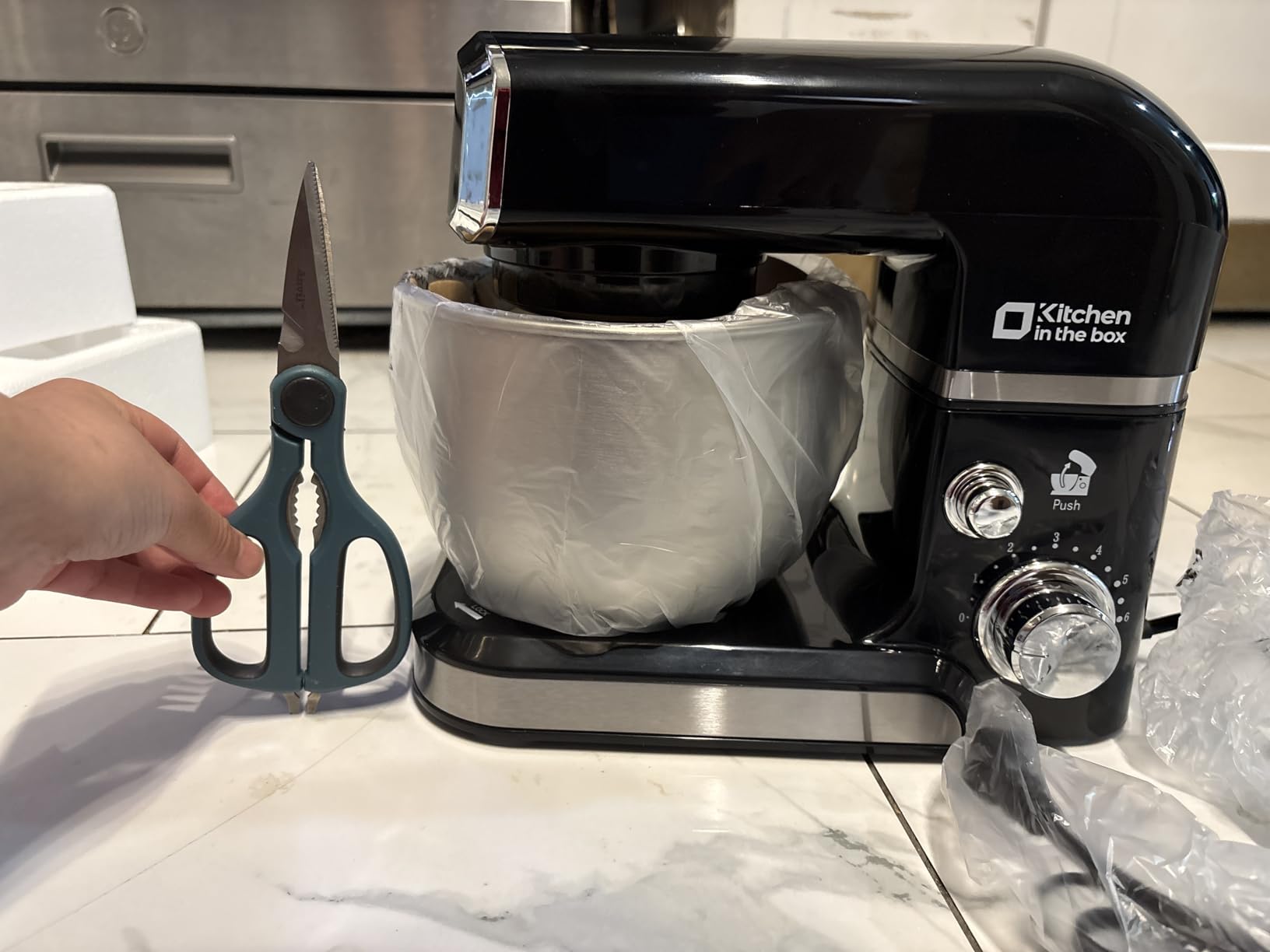
Kitchen in the Box mixer

Less than 7lbs, small and easy to storage

How I Tested It (And What I Paid Attention To)

I tried to think about this the way a normal home cook would—not someone testing machines all day, just someone making food throughout the week.

So I focused on a few realistic scenarios:

  • basic batters (pancakes, cakes, muffins)
  • cookie dough
  • whipped cream and lighter mixing
  • bread dough and heavier mixtures
  • cleanup and storage after use

At the same time, I compared what I saw with patterns from real customer reviews—especially where multiple people mentioned the same strengths or frustrations. That helped separate one-off issues from actual trends.

First Impressions: Small, Light, and Surprisingly Stable

Kitchen In A Box Stand Mixer

Multi Attachments – Aluminium dough hook and flat beater,stainless steel whisk

The first thing you notice is the size. This is not a “compact version” of a standard mixer—it’s genuinely small. That’s either exactly what you want, or the first sign that this might not be enough machine for you.

The weight is a big part of that experience. It’s light enough to move around easily, which matters more than people think. A lot of users mentioned switching from heavier mixers and appreciating that they could finally move this one without effort.

At the same time, it doesn’t slide around as much as you’d expect. The suction cups on the bottom actually do their job. Once it’s in place, it tends to stay there, even when mixing thicker ingredients.

So right away, it feels like a machine designed for smaller kitchens or people who don’t want a permanent countertop fixture.

Everyday Mixing: Where It Feels Most Natural

This is where the Kitchen in the Box mixer makes the most sense.

For lighter tasks—cake batter, pancake mix, frosting—it feels easy and straightforward. You turn it on, adjust the speed, and it just works. No surprises.

A lot of users describe it as “perfect for everyday use,” especially for smaller households.

Whipping cream and egg whites also works well. The whisk attachment is fast and doesn’t require much adjustment. This is probably one of the areas where the mixer feels closest to a full-size model.

And for beginners, that simplicity matters. Several people mentioned that this was their first stand mixer and that it was easy to figure out right away.

Cookie Dough and Thicker Mixes: Still Fine, But You Start Noticing Limits

Once you move into thicker doughs, the experience changes a bit.

It still works. Cookie dough comes together, mashed potatoes mix evenly, and most medium-thickness mixtures don’t cause problems. But you start to hear the motor working harder.

One user described it as the mixer “doing its best” when handling heavier ingredients, which is a pretty accurate way to put it.

It’s not struggling in a dramatic way—it’s just clear that this isn’t what the machine was primarily built for.

Another interesting detail: the mixer actually does a good job pulling ingredients from the sides of the bowl. In some cases, users even said it handled that better than older, more expensive mixers they had used.

Bread Dough: It Works… With Conditions

This is where expectations need to be realistic.

The mixer can handle bread dough—but only to a point. Smaller batches are fine. Softer doughs are fine. But once things get dense or you’re trying to mix a larger recipe, it starts to feel like you’re asking a bit too much.

Some users successfully made bread regularly with it, especially in small batches. Others noticed the machine getting warm or needing breaks during longer kneading sessions.

There’s also a recommended run time limit (often around 5–7 minutes), which becomes relevant here. If your recipe needs longer kneading, you’ll probably end up finishing by hand.

So yes, it can do bread. But it’s not really a “bread machine” in the way larger mixers are.

The Bowl Size: This Is the Real Limitation

If there’s one thing that comes up again and again in user feedback, it’s the bowl size.

Technically, it’s a 3.2-quart bowl. In practice, the usable capacity is noticeably less.

One reviewer tested it with water and found that while it technically holds around 12 cups, anything close to that would overflow during mixing. Realistically, you’re working with closer to half that if you want to avoid a mess.

This shows up in everyday use too:

  • you may need to split recipes into batches
  • adding ingredients mid-mix can feel cramped
  • larger recipes can get messy quickly

Some people are completely fine with this. Others end up wishing they had gone one size bigger. That split reaction really depends on how you cook.

Design Details That Actually Matter

There are a few small design choices that come up repeatedly in real use.

The splash guard helps, but the opening is small. You can pour liquids in, but adding dry ingredients while mixing is a bit awkward.

The tilt-head mechanism works fine, though some users mentioned it doesn’t open as wide as they expected, which makes adding ingredients slightly less convenient.

The attachments are mostly functional, though they feel more basic than premium. They get the job done, but you don’t get that heavy-duty feel you might expect from more expensive mixers.

On the plus side, the controls are simple and intuitive. There’s no learning curve here. You turn the dial, pick a speed, and start mixing.

Cleaning and Storage: One of Its Strongest Points

This is where the smaller size becomes a real advantage.

Cleaning is straightforward. Most parts rinse easily, and several components are dishwasher safe. Users consistently describe it as “easy to clean,” which is not something every mixer can claim.

Storage is even better. You don’t need to rearrange your kitchen to make space for it. It fits into smaller areas and can even be left on the counter without feeling intrusive.

For people with limited space, this alone can make the mixer worth considering.

Durability and Long-Term Use

This is one of the more mixed areas.

Many users report using the mixer regularly without issues, especially for lighter tasks. Some even used it frequently enough to support small baking projects or side businesses.

But there are also cases where heavy use caused problems—overheating, reduced power, or eventual failure after being pushed beyond its intended limits.

What’s important here is context. This is not designed for heavy, daily, high-volume use. When used within its range, it holds up well. When pushed beyond that, it may not last as long.

Pros and Cons After Real Use

After looking at how this mixer holds up across everyday batters, cookie dough, mashed potatoes, and smaller bread batches, the pros and cons are actually pretty clear. It is not one of those products that feels confusing after a while. The strengths make sense, and the weaknesses do too.

Pros

  • Easy to live with in a small kitchen. The compact size is a real advantage if you do not have much counter or cabinet space.
  • Light enough to move without it becoming a chore. That matters a lot more than people think, especially if a heavy mixer is the reason you avoid using one in the first place.
  • Good for smaller everyday jobs. It handles cake batter, pancake batter, cookies, mashed potatoes, whipped mixtures, and similar recipes pretty comfortably.
  • Stable while mixing. The suction cups seem to do their job well, so it does not slide around the counter as easily as you might expect from a lightweight mixer.
  • Beginner-friendly. The controls are simple, setup is straightforward, and it does not feel intimidating if this is your first stand mixer.
  • Reasonable value for the price. As long as you understand the size and limits, it gives you a useful stand mixer experience without the cost of a larger machine.

Cons

  • The bowl is smaller than many people expect in real use. The listed 3.2-quart size sounds more generous than it feels once ingredients are actually moving around.
  • Not ideal for large batches. If you regularly double recipes or bake for a crowd, it will start feeling cramped fast.
  • Heavy dough is possible, but not its strongest area. It can do some bread dough, but the motor and bowl both feel limited once recipes get dense or require longer kneading.
  • Ingredient adding can feel awkward. The opening is not especially generous, so adding flour or other dry ingredients while mixing is not always smooth.
  • It does not leave much room for error. With a bigger mixer, you can sometimes get away with overfilling slightly. Here, you usually cannot.

That is really the takeaway after testing what this kind of mixer is likely to be used for. The Kitchen in the Box mixer is at its best when you treat it like a compact everyday helper, not a scaled-down heavy-duty machine. Once you ask it to stay in that lane, it actually makes a pretty decent case for itself.

My experience with the Kitchen in the Box mixer ended up being a little more positive than I expected, mostly because I judged it as a small everyday appliance rather than a full-size mixer replacement. If you want a second opinion from a slightly different angle, this Kitchen in the Box stand mixer review is worth reading too.

Quick Comparison With Similar Small Mixers

Seeing how this mixer compares to other small models can help put things into perspective.

Feature Kitchen in the Box 3.2Qt Mixer Model Reviewed Dash Stand Mixer Hamilton Beach 3.5Qt Mixer
Size & Weight

How easy the mixer is to move and store

Very compact and lightweight Compact but slightly lighter Noticeably larger and heavier
Mixing Power

How well it handles thicker mixtures

Good for light to medium tasks Better for very light tasks Stronger for heavier mixing
Bowl Capacity

Usable space for recipes

3.2 qt (smaller usable capacity) 3 qt 3.5 qt
Best For

Who each mixer fits best

Small kitchens, everyday baking Very light use, occasional mixing Users needing more power
Main Trade-Off

What you are giving up

Limited capacity and power Less versatility Less compact

This mixer sits right in the middle: more capable than ultra-light options, but not as strong or spacious as larger models.

What It Does Well

  • Compact and easy to store
  • Lightweight and easy to move
  • Great for small batches and everyday recipes
  • Simple controls, beginner-friendly
  • Stable on the counter thanks to suction feet
  • Good value for the price

Where It Struggles

  • Smaller usable bowl capacity than advertised
  • Not ideal for large batches
  • Limited power for heavy dough
  • Needs breaks during longer mixing sessions
  • Adding ingredients mid-mix can feel cramped

Who This Mixer Makes Sense For

This mixer works best if:

  • you cook or bake in small batches
  • you have limited counter space
  • you want something lightweight and easy to use
  • you are just getting into baking

It’s probably not the right choice if:

  • you regularly bake in large quantities
  • you make dense bread dough often
  • you want a long-term heavy-duty mixer

How It Compares to the KitchenAid Artisan Mini 3.5 Quart

This is probably the comparison people make most often, and honestly, it makes sense. On paper, the Kitchen in the Box mixer and the KitchenAid Artisan Mini 3.5 Quart Tilt-Head Stand Mixer seem like they belong in the same conversation: both are smaller stand mixers aimed at people who do not want a huge machine taking over the kitchen. But once you look a little closer, they are not really playing the same game. The Kitchen in the Box uses a 3.2-quart bowl, 6 speeds, and a 300W motor, while the Artisan Mini is a 3.5-quart tilt-head model with 10 speeds and KitchenAid’s more established premium positioning.

The bigger difference, though, is not really the spec sheet. It is the expectation. The KitchenAid Artisan Mini is the one people buy when they want a smaller mixer that still feels like a “real” KitchenAid. The Kitchen in the Box is more of a budget-minded compact mixer for smaller households, beginners, or people who just want something light and easy to store. That distinction matters because the price gap between them is not small. It is massive. Recent Amazon results show the Kitchen in the Box often sitting around the low-budget range, roughly around the $50 to $60 territory in deals and listings, while the KitchenAid Artisan Mini is typically several times more expensive.

That means this is not really a fair one-to-one battle in the usual sense. The KitchenAid should feel more refined. It should have better long-term confidence behind it. And frankly, it should, because it costs so much more. The more useful question is whether that price jump actually makes sense for the way you bake.

Feature Kitchen in the Box 3.2Qt Mixer Model Reviewed KitchenAid Artisan® Mini 3.5 Quart Tilt-Head Stand Mixer
Basic Positioning

What kind of buyer each model seems built for

Budget-friendly compact mixer for small kitchens and lighter everyday use Premium compact mixer for buyers who want the KitchenAid experience in a smaller format
Bowl Size

How much space you get before things start feeling cramped

3.2 quarts 3.5 quarts
Speed Settings

More speeds can help with control, especially for lighter mixing tasks

6 speeds 10 speeds
Motor / Mixing Setup

The basic mechanical starting point

300W, compact tilt-head style mixer Tilt-head KitchenAid platform with 10-speed control
Everyday Feel

How the mixer is likely to feel in normal home use

Lighter, simpler, easier to justify for occasional or small-batch use More polished and more established, but also more of an investment
Main Trade-Off

What you are giving up in exchange for the price and size

Less power, less room, and less long-term confidence than a premium mixer Far higher cost for a mixer that is still relatively small
Price Reality

What this comparison really comes down to

Much cheaper Much more expensive

The biggest thing here is not the extra 0.3 quart. It is the price gap. The Artisan Mini may be the nicer machine, but it is also in a completely different budget conversation.

If I were being blunt about it, the KitchenAid Artisan Mini is the better fit for someone who already knows they want a KitchenAid and is specifically shopping for a smaller one. The Kitchen in the Box mixer makes more sense for someone who mostly wants a compact mixer that handles ordinary home baking without costing several times as much.

And that is really the conclusion I would underline. Yes, the Artisan Mini is the more premium option. It should be. But the difference in price is so wide that comparing them too directly can get a little silly. For many people, the Kitchen in the Box is not competing with the Artisan Mini on refinement. It is competing on affordability. And on that point, the gap is not just noticeable—it is the whole story.

The Part No One Mentions: This Mixer Changes How You Cook (A Little)

One thing I didn’t expect is that a small mixer like this actually changes your habits a bit.

Not in some dramatic way. But enough to notice.

When you have a big, heavy stand mixer, you tend to plan around it. You don’t pull it out unless you’re baking something “worth it.” Bread. Big batches. Something that justifies the effort.

This one is different.

Because it’s small, already sitting there, and easy to use, you end up using it for things you normally wouldn’t bother with. Quick frosting. Mixing mashed potatoes instead of doing it by hand. Even random things like whipping a small batch of cream just because you can.

A few users described this without really saying it directly—they started using it more often than expected, not because it was powerful, but because it was convenient.

That’s kind of the quiet advantage here. It’s not about replacing a bigger mixer. It’s about lowering the “effort barrier” to using one at all.

Of course, that only works up to a point. The same convenience that makes you use it more often also makes its limits more obvious. Once you try to stretch it beyond small, quick jobs, the illusion breaks a little.

But for everyday cooking? That “always ready” feeling is actually one of its best features.

What It Feels Like After a Month (Not Just the First Impression)

First impressions with this mixer are usually positive. It looks good, it works, it feels like a smart purchase for the price.

The more interesting question is what happens after a few weeks.

That’s where the experience settles into something more realistic.

For a lot of people, it becomes a “go-to” tool for smaller jobs. You don’t think about it much—you just use it. That’s usually a good sign. It means the tool fits naturally into your routine.

But you also start to notice patterns:

  • you avoid overfilling the bowl because you know it gets messy
  • you instinctively keep dough batches smaller
  • you don’t expect it to handle long mixing sessions without breaks

None of that feels like a dealbreaker. It just becomes part of how you use it.

One review stood out to me—someone said it worked great for their needs, but if they were still baking like they did years ago, it wouldn’t have been enough.

That’s probably the most honest long-term take.

This isn’t a mixer you “grow into.” It’s a mixer that either matches your current habits… or doesn’t.

If it does, it ends up feeling like a practical, everyday tool you’re glad to have. If it doesn’t, you’ll start noticing the limits pretty quickly—and once you see them, it’s hard to unsee them.

Availability Right Now (And What That Tells You)

One thing that stood out while looking into the Kitchen in the Box mixer recently is how quickly certain versions go in and out of stock.

The more neutral colors—especially black and white—tend to sell out faster than the brighter options. That’s not surprising. Those are the colors most people default to, especially if the mixer is going to live on the counter full-time. But it does mean you may not always find the exact version you want available at any given moment.

That kind of availability pattern usually says something. It doesn’t automatically mean the product is amazing, but it does suggest there’s steady demand, especially in the budget mixer category.

Check Latest Price on Amazon

It also lines up with the overall rating. Right now, the mixer sits at around 4.4 out of 5 stars with roughly 8,900 reviews on Amazon. That’s a pretty large sample size, and it’s hard to maintain a rating like that if a product is consistently disappointing people.

Looking through the reviews, the feedback feels fairly balanced. Most buyers seem happy with what they got, especially considering the price and size. At the same time, the lower ratings point to predictable issues—limited power, smaller capacity, and occasional durability concerns.

So the rating doesn’t suggest this is some hidden “perfect” product. It suggests something more realistic: a mixer that works well for a lot of people, as long as they understand what they’re buying.

And honestly, that might be the most accurate signal you can get from numbers like this. It’s not exceptional. It’s not terrible. It just lands in that middle ground where expectations matter more than anything else.

If you want to look at the official version of the product before deciding, you can also check the manufacturer’s page here.

One Last Thought

The Kitchen in the Box mixer makes the most sense once you stop judging it like a full-size stand mixer.

It is smaller, lighter, and clearly built for a different kind of kitchen. That is not really a flaw on its own. In fact, for some people, that is the whole point. If you mostly make smaller batches, do not want a heavy machine parked on the counter, and just need something for everyday mixing, it can actually be a pretty useful little appliance.

Where people get disappointed is usually when they expect it to do more than it realistically can. It will mix cake batter, cookie dough, mashed potatoes, and even some bread dough. But it does not have much extra room, either in the bowl or in the motor. You feel that pretty quickly once recipes get bigger or heavier.

So no, I would not call it a mini KitchenAid replacement. That feels like the wrong expectation from the start. It is more like a budget-friendly mixer for small kitchens and smaller households that happens to do its job better than you might expect, as long as you do not push it too far.

That is really what it comes down to. If your cooking style matches the size and limits of this mixer, it can be a genuinely satisfying buy. If not, it will probably start feeling cramped and a little underpowered before you have even finished your second recipe.

Marissa Cole

About the Author

Marissa Cole

Marissa Cole writes about kitchen equipment with a particular interest in the small design details that end up mattering once a product is actually in use. She has spent years looking closely at stand mixers, bowls, attachments, and everyday countertop tools, paying attention to the kinds of things that rarely stand out on a product page but quickly become noticeable in a real kitchen.

Her work tends to focus less on marketing claims and more on daily usability—how a bowl feels to hold, whether an attachment fits the way it should, how easy something is to clean when batter dries in the corners, or whether a tool still feels convenient after the novelty wears off. Drawing from product research, customer feedback, and practical kitchen habits, Marissa aims to help readers sort through the noise and choose equipment that feels genuinely useful over time, not just impressive at first glance.

KitchenDict

The modern dictionary of kitchen tools and appliances.

Honest reviews, practical comparisons,
and research-based buying guides for everyday home kitchens.

Honest Reviews Practical Comparisons Research-Based Guides Kitchen Product Insights
About Contact Privacy Policy Affiliate Disclosure
© 2026 KitchenDict. All rights reserved.