Modern kitchens are filled with tools designed to make cooking faster and more efficient. Two of the most common food preparation tools are the vegetable chopper and the food processor. At first glance, these appliances may seem very similar because both are used to chop and prepare ingredients. However, they are designed for different purposes and can perform very different tasks in the kitchen.
If you’re mainly looking for quick and simple vegetable prep, many home cooks prefer using a dedicated chopper. In fact, many of the best vegetable choppers are designed specifically to dice ingredients like onions, tomatoes, cucumbers, and peppers in seconds while keeping the kitchen counter clean and organized.
A vegetable chopper with container is typically a compact tool built for fast dicing and everyday meal preparation. A food processor, on the other hand, is a larger and more powerful electric appliance capable of handling a much wider range of tasks such as chopping, slicing, shredding, blending, and even kneading dough.
Choosing between these two kitchen tools depends largely on your cooking habits, available kitchen space, and the type of recipes you prepare most often. Some people prefer the simplicity and speed of a manual vegetable chopper, while others benefit from the versatility and power of a full-size food processor.
In this guide, we’ll compare vegetable choppers and food processors in detail, explain their key differences, and provide practical examples so you can decide which option makes the most sense for your kitchen and cooking routine.
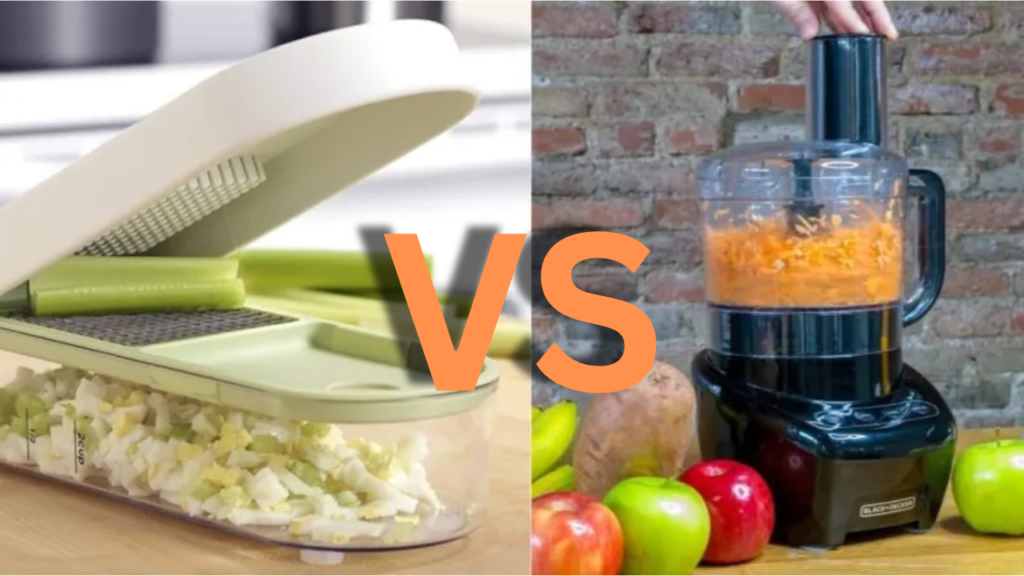
Quick Comparison: Vegetable Chopper vs Food Processor
| Feature | Vegetable Chopper | Food Processor |
|---|---|---|
|
Power Source
How the tool operates |
Usually manual | Electric motor |
|
Main Purpose
Primary function in the kitchen |
Chopping vegetables | Multiple food prep tasks |
|
Size
Typical appliance size |
Compact | Larger countertop appliance |
|
Cleaning
Ease of washing after use |
Very easy | More parts to clean |
|
Price
Typical price range |
$15 – $40 | $50 – $200+ |
|
Best For
Typical use case |
Quick daily chopping | Versatile food preparation |
Vegetable choppers are usually simpler and cheaper, while food processors offer more versatility for larger or more complex food preparation tasks.
Vegetable choppers are usually best for quick daily tasks, while food processors offer more versatility for larger food preparation jobs.
What Is a Vegetable Chopper?
A vegetable chopper is a simple kitchen gadget designed primarily to dice or chop vegetables quickly. Most models include a blade grid that pushes vegetables through sharp stainless steel blades when pressure is applied. The chopped ingredients fall directly into a container below the blade.
Vegetable choppers are extremely popular among home cooks because they make repetitive chopping tasks much faster. Instead of spending several minutes dicing onions or tomatoes with a knife, you can prepare them in seconds using a chopper.
Many modern vegetable choppers also include interchangeable blades for slicing, julienning, or grating. This adds extra versatility while still keeping the tool compact and easy to use.
Example: Fullstar Vegetable Chopper
One of the most popular manual choppers is the Fullstar Vegetable Chopper. This model includes multiple blade attachments and a container that collects chopped ingredients. It’s commonly used for onions, cucumbers, tomatoes, and peppers.
Advantages of Vegetable Choppers
- Very affordable
- Compact and easy to store
- No electricity required
- Quick setup and cleaning
- Great for everyday vegetable prep
Limitations
- Limited functionality
- Not ideal for large batches
- Cannot blend or puree food
What Is a Food Processor?
A food processor is a powerful electric appliance designed to handle many different food preparation tasks. It typically includes a motorized base, a large processing bowl, and multiple blade attachments.
Unlike a simple vegetable chopper, a food processor can chop, slice, shred, puree, mix, and even knead dough. Because of this versatility, it is often considered one of the most useful appliances in a modern kitchen.
Food processors are especially helpful when preparing large meals or complex recipes that require multiple preparation steps.
Example: Cuisinart Food Processor
The Cuisinart Food Processor is one of the most trusted options in this category. It includes multiple blades and discs for chopping vegetables, shredding cheese, slicing vegetables, and mixing dough.
Advantages of Food Processors
- Extremely versatile
- Handles large quantities of food
- Powerful motor
- Multiple attachments for different tasks
- Can puree and blend ingredients
Limitations
- More expensive
- Takes up more counter space
- Requires electricity
- More parts to clean
Key Differences Between Vegetable Choppers and Food Processors
Although vegetable choppers and food processors may appear similar at first glance, they are designed for very different purposes in the kitchen. Understanding how they differ in functionality, speed, convenience, and cost can help you choose the right tool for your cooking style. Below are the most important factors that separate these two popular kitchen appliances.
1. Versatility
The biggest difference between these tools is versatility. A vegetable chopper is designed primarily for one main task: quickly chopping or dicing vegetables. Most models use a blade grid or pull-cord system that allows users to chop onions, tomatoes, cucumbers, peppers, and other vegetables in seconds. Some advanced models include interchangeable blades for slicing or shredding, but their functionality still focuses mainly on vegetable preparation.
A food processor, on the other hand, is a multifunction kitchen appliance capable of handling a much wider range of food preparation tasks. In addition to chopping vegetables, it can slice vegetables evenly, shred cheese, grind nuts, puree sauces, blend ingredients, and even knead dough for bread or pizza. Because of its versatility, a food processor can often replace several smaller kitchen gadgets.
For example, if you want to quickly dice onions for tacos or prepare chopped vegetables for a salad, a vegetable chopper works perfectly. But if you need to make hummus, shred cheese, slice potatoes for gratin, and mix dough for bread, a food processor is far more capable.
2. Speed and Power
Food processors are powered by electric motors that rotate sharp blades at high speeds. This allows them to process ingredients extremely quickly and handle large batches of food with minimal effort. The motor power also allows food processors to process tougher ingredients such as nuts, dense vegetables, or thick dough.
Vegetable choppers typically rely on manual pressure, a push-down mechanism, or a pull-cord system. While this manual operation works very well for chopping vegetables, it naturally limits the amount of food that can be processed at once. For small tasks, however, manual choppers can actually feel faster because they require almost no setup time.
In practical terms, a vegetable chopper is ideal for quickly preparing a few vegetables, while a food processor is better suited for large cooking projects or meal preparation sessions.
3. Ease of Cleaning
Cleaning is another important factor that many home cooks consider when choosing between these tools. Vegetable choppers usually have a very simple design consisting of a blade grid, lid, and container. Because there are only a few parts, they are generally quick and easy to rinse under running water. Many models are also dishwasher-safe.
Food processors tend to have more components, including a motor base, processing bowl, lid, and several interchangeable blades or discs. While many of these parts are dishwasher-safe, cleaning them can still take more time compared to a simple chopper. Additionally, the motor base must be wiped carefully instead of submerged in water.
For people who prefer tools that are easy to clean and maintain, vegetable choppers often have a slight advantage.
4. Kitchen Space
Kitchen space can also influence your choice. Vegetable choppers are typically compact and lightweight, making them easy to store in a drawer or small cabinet. Many models are designed to take up minimal counter space, which makes them especially appealing for apartments or small kitchens.
Food processors are larger appliances that usually require more storage space. Even compact models can take up a noticeable amount of cabinet space due to the motor base and multiple attachments. Some home cooks choose to leave them on the countertop for easy access, but this requires sufficient kitchen space.
5. Cost
Price is another major difference between the two tools. Manual vegetable choppers are generally very affordable, with many high-quality models costing between $15 and $40. This makes them a popular choice for budget-conscious cooks who simply want a faster way to chop vegetables.
Food processors are significantly more expensive because they include a motor, multiple blades, and more advanced features. Entry-level food processors typically start around $50, while high-end models can cost $200 or more. However, their ability to perform many different kitchen tasks can justify the higher price for frequent cooks.
Which One Should You Choose?
The best choice ultimately depends on how you cook and what tasks you perform most often in the kitchen.
If you primarily need a simple tool to speed up everyday vegetable preparation—such as chopping onions, tomatoes, cucumbers, or peppers for salads and stir-fries—a vegetable chopper is usually the better option. It is compact, affordable, easy to clean, and extremely convenient for quick daily cooking tasks.
However, if you enjoy cooking complex recipes, preparing sauces, shredding cheese, slicing vegetables evenly, or making dough for bread and pizza, a food processor can be a much more valuable investment. Its versatility allows it to handle many different preparation tasks that would otherwise require multiple kitchen tools.
When It Makes Sense to Own Both
Many experienced home cooks find that the best solution is actually owning both tools. Each one excels at different tasks, and using them together can make food preparation more efficient.
A vegetable chopper is perfect for quick daily jobs like dicing onions or chopping vegetables for a salad. It requires almost no setup and can be cleaned in seconds. Meanwhile, a food processor is extremely helpful for larger cooking projects such as preparing sauces, slicing vegetables for casseroles, shredding cheese, or mixing dough.
By using the right tool for each task, you can significantly reduce preparation time and make cooking more enjoyable. Instead of struggling with repetitive knife work or complicated preparation steps, these kitchen tools allow you to focus on what matters most—creating delicious meals.
Final Verdict
Both vegetable choppers and food processors are valuable kitchen tools, but they serve different purposes.
Vegetable choppers are compact, affordable, and ideal for quick daily food preparation.
Food processors offer far greater versatility and power, making them perfect for more complex cooking tasks.
If you cook frequently and enjoy experimenting with recipes, a food processor can be a great long-term investment. But if you simply want to speed up everyday vegetable prep, a vegetable chopper may be all you need.
About KitchenDict
KitchenDict is more than just a product review website — it’s designed to be a living encyclopedia of modern kitchen tools. Our team spends countless hours researching, comparing, and analyzing cookware, appliances, and kitchen gadgets used by real home cooks. By combining hands-on testing, long-term market observation, and detailed product research, KitchenDict provides reliable insights that help readers make smarter buying decisions. From everyday vegetable choppers to advanced cooking appliances, our goal is simple: help you understand what truly works in the kitchen and choose tools that make cooking easier, faster, and more enjoyable.
