A good stand mixer earns its space the hard way. It is one of those appliances that can seem a little excessive until you start baking more often, making bread regularly, or getting tired of mixing thick dough by hand. Then it starts to feel less like a luxury and more like one of the few countertop tools that genuinely pulls its weight.
There are a lot of options out there now, and not all of them make sense for the average home kitchen. Some are built for occasional cookies and cake batter. Others are better suited to frequent baking, heavier doughs, or cooks who want room to grow into extra attachments over time. If you are trying to narrow things down, this guide to the best stand mixers for home use is a good place to start. The models below stand out for a mix of performance, versatility, and everyday usability, which matters a lot more than flashy marketing once the mixer is actually sitting on your counter.
1. KitchenAid Artisan Series — Still One of the Easiest Mixers to Recommend
Overview: The KitchenAid Artisan Series has managed to stay relevant for years, which honestly says a lot in a category where newer models keep promising more power, more features, and more attachments. The reason it still gets recommended so often is pretty simple: it fits the way most people actually bake at home. It is not overly complicated, it does not take up a ridiculous amount of space, and it handles the kinds of jobs home bakers run into most often without making the whole process feel fussy. For cookies, cake batters, frostings, mashed potatoes, whipped cream, and even smaller batches of bread dough, it tends to feel very comfortable and predictable in use.
The 5-quart stainless steel bowl hits a nice middle ground. It is large enough for family-size recipes, weekend baking projects, and holiday batches, but not so oversized that the mixer starts to feel bulky for normal everyday cooking. That balance is part of why the Artisan is so easy to live with. It feels substantial, but it still belongs in a regular home kitchen rather than looking like a machine designed for semi-commercial use.
Its 10-speed control also makes the mixer feel versatile without being intimidating. Lower speeds work well for gently combining dry ingredients or starting thicker mixtures without sending flour everywhere, while the higher settings are useful for whipping cream, egg whites, and lighter batters that need a bit more aeration. On paper, that may sound standard now, but in daily use it matters. A mixer that feels easy to control tends to get used more often, and the Artisan has always done a good job there.

Performance: In real kitchen use, the KitchenAid Artisan stands out less because it dominates every single mixing task and more because it handles a wide range of tasks consistently well. That distinction matters. This is not necessarily the most specialized mixer for heavy bread baking, nor is it the most powerful option you can buy for the money, but it is one of the most balanced. It performs well enough across many different recipes that it makes sense for a broad range of home cooks.
For everyday baking, it tends to feel especially capable. Cookie doughs, cake batters, buttercream, brownie mixes, and muffin batters are right in its comfort zone. It also does a very good job with whipped cream and meringue-style tasks when paired with the whisk attachment. Bread dough is where expectations should be a bit more realistic. It can absolutely handle dough, especially softer sandwich breads, pizza dough, cinnamon roll dough, and moderate batches of enriched breads. But if you regularly make very dense whole grain dough or especially large batches, this is the point where some buyers start looking at heavier-duty alternatives. That is not really a knock on the Artisan so much as a reminder that it is an all-purpose home mixer first, not a dedicated dough machine.
The 325-watt motor has been debated for years because wattage tends to get overused in product comparisons. In practice, the Artisan’s real advantage is not just raw motor size but how well the machine works as a whole. It generally feels steady, dependable, and well-matched to the tasks most people actually use it for. There is a reason so many home bakers keep using these mixers for years. They are not perfect, but they are rarely confusing or frustrating in everyday use.
Attachments: One of the biggest reasons people stay loyal to the Artisan is the attachment ecosystem. This is where the mixer becomes more than just a baking tool. Once you start looking at the available add-ons, it turns into a much broader kitchen machine. Pasta rollers, pasta cutters, food grinders, slicer and shredder attachments, spiralizers, grain mills, and ice cream accessories all expand what the machine can do beyond mixing alone.
That flexibility gives the Artisan a kind of long-term value that is easy to underestimate at first. Even if someone buys it primarily for cakes and cookies, there is a good chance they will eventually start exploring attachments that help with pasta making, vegetable prep, or meat grinding. Of course, not everyone needs all of that, and not every attachment ends up being equally useful in a real kitchen. But it is a genuine advantage to have those options available without needing to buy an entirely separate appliance for every task.
That is also part of why the Artisan remains such a practical choice for people building out a kitchen over time. It does not force you to go all in at once. You can start with the mixer itself, then add tools later if they match the way you actually cook. That feels a lot smarter than buying several specialty appliances that may or may not earn permanent counter or cabinet space.
Design and Everyday Usability: A big part of the Artisan’s appeal comes down to how approachable it feels. The tilt-head design is simple and familiar. Locking the bowl in place is straightforward, the controls are intuitive, and changing attachments does not take much effort. That might sound basic, but it matters more than people sometimes admit. A stand mixer can be technically capable and still end up annoying to use if the workflow feels awkward. The Artisan usually avoids that problem.
Its size also works in its favor. It feels sturdy on the counter, but not overwhelmingly large. For many people, it is the kind of mixer that can stay out full-time without making the kitchen feel crowded. And visually, it still has a lot going for it. The design is recognizable, the finish options are varied, and it is one of the few stand mixers people often choose partly because they like how it looks in the kitchen. That may sound superficial, but appliances that are both functional and pleasant to live with tend to get more use.
Trade-Offs: As widely liked as the KitchenAid Artisan is, it is not the automatic best choice for everyone. The biggest limitation shows up when buyers expect it to behave like a heavier-duty dough mixer. If bread baking is the main priority, especially large or frequent bread batches, there are other mixers that make a stronger case. The Artisan is versatile, but there are limits to how far that versatility goes before a more dough-focused machine becomes the better fit.
Another thing worth mentioning is that part of what you are paying for is the complete package: the design, the brand trust, the attachment system, the widespread familiarity, and the proven track record. If someone only wants a mixer for occasional batters and basic dough, there are cheaper machines that can technically do the job. The Artisan keeps earning recommendations because it tends to feel like a better long-term appliance, not because it is always the lowest-cost answer.
Warranty: KitchenAid backs the Artisan Series with a 1-year warranty, which is fairly standard in this category. Still, the more reassuring part is really its long-standing reputation. This is one of those mixers that people often buy expecting to keep for a long time, and that expectation is a big part of its appeal. It is not just about the warranty period itself. It is about the sense that the mixer is built to remain useful well beyond it.
2. Cuisinart SM-50 — A Stronger Value Than Many People Expect
Overview: The Cuisinart SM-50 tends to be one of those mixers that gets less attention than KitchenAid, but it deserves a closer look. For buyers who want a stand mixer that feels a little more robust without jumping too far up in price, it can be a very appealing middle-ground option. It has a 5.5-quart stainless steel bowl, which gives it slightly more room than the classic 5-quart setup, and that extra capacity can be useful for larger cookie batches, layered cakes, and family-size recipes.
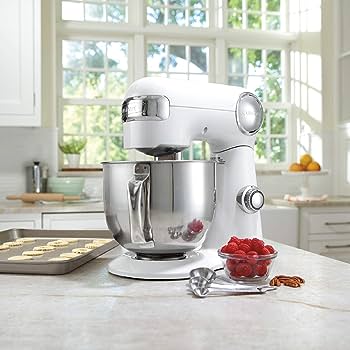
The 500-watt motor also gives the SM-50 a stronger on-paper profile than many comparable home mixers. More importantly, it tends to feel capable in practice. It handles thicker doughs and heavier batters with a bit more confidence than some entry-level options, which makes it attractive for home bakers who want a mixer that feels sturdy and a little less entry-level without going into premium pricing territory.
Performance: In day-to-day use, the Cuisinart SM-50 feels like a mixer designed for people who bake often enough to appreciate a little extra muscle. It is well-suited to cookie dough, cakes, frostings, muffins, and standard bread dough recipes, and the larger bowl gives it a bit more breathing room for bigger batches. The 12-speed settings also give it a wider control range, which can be useful when switching between gentle folding-style tasks and more energetic whipping or beating.
It is one of those mixers that often appeals to buyers who want something a little more substantial than a budget model but are not completely sold on paying for the most recognizable brand name alone. It feels capable, practical, and well-positioned for people who expect to use their stand mixer regularly rather than occasionally.
Attachments: Cuisinart offers optional attachments for the SM-50, which helps extend its value beyond basic mixing. While the attachment range may not feel quite as iconic or expansive as KitchenAid’s, it still gives the machine more flexibility than a mixer that is limited to only its included tools. For buyers who like the idea of building out a kitchen setup gradually, that is a real advantage.
Warranty: One of the strongest points in the Cuisinart SM-50’s favor is the 3-year warranty. That is more generous than what many competitors offer, and it adds a layer of reassurance for buyers who want a machine that feels like a more deliberate long-term purchase.
3. Breville BEM800XL — Built for Bakers Who Like More Control
Overview: The Breville BEM800XL has always stood out a bit because it feels like it was designed for buyers who care about mixing precision, not just brand familiarity. One of its most notable features is load-sensing technology, which adjusts the mixer’s speed depending on the resistance in the bowl. That sounds like a small technical detail, but it can make the machine feel more controlled and consistent, especially when switching between lighter mixtures and thicker doughs.

With 12 speed settings and a 5-quart stainless steel bowl, the Breville sits comfortably in the category of full-size home stand mixers, but it brings a slightly more engineered feel to the experience. It is not just trying to be pretty on the counter. It is trying to give the user more control over the process.
Performance: The load-sensing system is the real talking point here. Instead of treating every recipe the same way, the mixer responds to what it is actually mixing. That can lead to more consistent results, especially for bakers who care about how evenly ingredients are incorporated. It is good at typical stand mixer tasks like kneading dough, whipping cream, beating butter and sugar, and mixing batters, but the thing that makes it memorable is the sense of deliberate control it offers.
For home bakers who like equipment that feels slightly more technical and less purely decorative, the Breville has a lot of appeal. It feels like a mixer for people who notice details in the mixing process and care about repeatable results.
Attachments: The Breville does not rely on a massive attachment system to sell itself. Its strength is more about what it already does as a mixer. That can actually be a positive for buyers who do not want to build an entire appliance ecosystem and just want a machine that performs well at core mixing tasks.
Warranty: Breville includes a 1-year warranty with the BEM800XL, which is in line with what many buyers expect in this category. The stronger selling point is really the machine’s thoughtful design and focus on mixing accuracy rather than sheer accessory count.
4. Hamilton Beach 63325 — A Reasonable Entry Point for Casual Bakers
Overview: Not everyone needs a premium stand mixer, and that is exactly where the Hamilton Beach stand mixer makes sense. It is a more affordable option aimed at buyers who want the convenience of a stand mixer without committing to the cost of a higher-end machine. With a 300-watt motor, a 3.5-quart stainless steel bowl, and six speed settings, it is clearly a more modest machine, but that does not automatically make it a bad one. It just means expectations should stay grounded.
Performance: For lighter kitchen work, the Hamilton Beach 63325 can be a very practical choice. It handles cake batters, cookie doughs, whipped cream, and standard everyday mixing jobs well enough for many casual home bakers. Its planetary mixing action helps it mix more thoroughly than very basic stationary beaters, which gives it an advantage if someone wants something more capable than a hand mixer but is not ready to spend much more.
Where it starts to show its limits is with very heavy doughs or frequent demanding use. This is not really the mixer for someone planning to bake dense bread every weekend. But for occasional baking, holiday dessert prep, and general kitchen use, it offers a level of convenience that makes sense for the price.
Attachments: This is not a mixer people buy for an elaborate attachment ecosystem. It is more of a straightforward, budget-conscious tool. And honestly, that is fine. Not every stand mixer needs to become a full kitchen hub. Sometimes a simpler machine is exactly the right answer.
Warranty: Hamilton Beach includes a 1-year warranty, which feels appropriate here. The bigger appeal is affordability and accessibility rather than premium long-term expandability.
5. Smeg SMF03 — Style-Forward, but Still a Serious Mixer
Overview: The Smeg stand mixer gets attention immediately because of how it looks. Its retro-inspired design is undeniably one of its main selling points, and for some buyers that alone gives it a strong place in the conversation. But the SMF03 is not just about appearance. Underneath the styling, it is still a full-size stand mixer with a 5-quart stainless steel bowl and 10-speed control, which makes it suitable for a wide range of everyday baking tasks.
Performance: In actual use, the Smeg does what a good home stand mixer should do. It handles cakes, cookies, whipped mixtures, frostings, and moderate dough work with the kind of versatility most home bakers need. It may not be the most aggressive value in the category, and it may not be the first choice for buyers who care only about raw mixing power, but it has the advantage of offering both functional performance and distinctive style in one machine.
Attachments: The Smeg SMF03 does not overwhelm buyers with an endless attachment narrative, but that is not necessarily a weakness. For some people, the draw is more about having a stylish, capable stand mixer that fits seamlessly into the kitchen without trying to become every appliance at once. Its die-cast aluminum body also helps reinforce the sense that this is more than just a decorative purchase.
Warranty: Smeg provides a 1-year warranty for the SMF03. Like several others in this category, its appeal goes beyond the warranty period and into how well it balances design, performance, and day-to-day usability.
Now, let’s take a broader look at what really separates these mixers and how to think about them in a practical home-kitchen context.
KitchenAid Artisan Series — Why It Keeps Showing Up on So Many Recommendation Lists
The KitchenAid Artisan Series remains one of the easiest mixers to recommend because it sits in that sweet spot between performance, familiarity, and long-term flexibility. It feels right for the kind of baking many households actually do. It is approachable enough for beginners, dependable enough for frequent use, and expandable enough to stay interesting over time if you start experimenting with attachments.
Performance: With 10 speed settings and a 5-quart bowl, it offers enough range for everyday mixing tasks without feeling overly technical. It performs well on whipped mixtures, cake batters, cookie dough, frosting, and moderate bread recipes. Its 325-watt motor may not dominate spec-sheet comparisons, but in everyday use the Artisan is less about brute force and more about consistency and ease.
Attachments: This is still one of the model’s biggest strengths. The ability to add pasta makers, food grinders, slicers, and more gives it a kind of modular long-term usefulness that many competitors cannot match as easily.
Warranty: KitchenAid includes a 1-year warranty, though the real reassurance comes from the machine’s track record and how commonly it remains in kitchens for years.
Cuisinart SM-50 — A Strong All-Rounder With a Little More Muscle
The Cuisinart SM-50 deserves more attention than it usually gets. It combines a larger 5.5-quart bowl, a 500-watt motor, and 12 speed settings into a package that feels well suited to home bakers who want something capable but not unnecessarily flashy.
Performance: It handles bigger batches comfortably and feels strong enough for heavier batters and more demanding kitchen tasks. This can make it especially attractive for families or regular bakers who want a little more room and a little more power without making a huge leap into premium pricing.
Attachments: While it does not have the same level of attachment recognition as KitchenAid, it still offers enough expandability to feel like more than a one-purpose appliance.
Warranty: The 3-year warranty remains one of the most compelling details here, especially for buyers who value a stronger manufacturer commitment.
Breville BEM800XL — A More Technical Take on Stand Mixing
The Breville BEM800XL appeals to a slightly different kind of buyer. It feels more intentional, more engineered, and more focused on control than visual familiarity.
Performance: Its load-sensing technology helps it adapt to what is in the bowl, which can make mixing feel more consistent. Combined with 12 speed settings and a 5-quart bowl, it offers a refined experience for bakers who like precision.
Attachments: Its strength is not really about having dozens of add-ons. It is more about doing the core mixing job especially well.
Overall
Choosing the best stand mixer for home use is rarely just about picking the most powerful motor or the flashiest design. What matters more is how closely the mixer matches the way you actually cook and bake. Some buyers need a reliable all-around machine that can handle cookies, cakes, frosting, and occasional dough without much fuss. Others want something with more power, more bowl space, or more control because they bake often enough to notice the difference. And some people simply want a mixer that feels good to use and looks good enough to leave on the counter every day.
That is why these mixers make sense as a group. They each represent a different kind of value. The KitchenAid Artisan Series remains one of the strongest all-purpose picks because it is so easy to live with and so flexible over time. The Cuisinart SM-50 makes a strong case for buyers who want more power and a longer warranty. The Breville BEM800XL stands out for control and thoughtful engineering. The Hamilton Beach 63325 keeps the category accessible for more casual bakers or tighter budgets. And the Smeg SMF03 proves that style and performance do not always have to live in separate appliances.
Price, of course, matters. Some of these mixers ask for a higher upfront investment, and that can be worth it if the machine genuinely fits your habits and earns regular use. In some cases, paying more gets you better build quality, a stronger attachment system, more refined control, or simply a mixer that feels more satisfying to own for years. In other cases, a simpler and less expensive model may be the smarter purchase because it covers everything you realistically need.
The best way to judge them is not by asking which one is “best” in the abstract. It is by asking which one fits your kitchen, your recipes, your budget, and your expectations. If you mainly bake birthday cakes, cookies, and weekend desserts, you probably do not need the same machine as someone making bread every other day. If you value expandability, that changes the equation. If you care about design and countertop presence, that changes it too.
So in the end, the right stand mixer is the one that feels useful often enough to justify its space. That is really the whole game. A good mixer should make baking easier, more consistent, and a little more enjoyable. The best one for you is the one that actually gets used, not the one that only looks impressive in a product roundup.
