If you’re trying to decide between the KitchenAid Artisan vs Classic stand mixer, you’re definitely not the only one. These two mixers show up in almost every search when people start looking for a reliable stand mixer for home baking.
I remember going through the same comparison not long ago while helping a friend pick her first stand mixer. At first they looked nearly identical. Same tilt-head design. Same iconic KitchenAid look. Same basic attachments.
But after digging into specs and reading through a lot of user reviews, a few differences started to stand out. The bowl size is slightly different, the motor power isn’t exactly the same, and even small details like the bowl handle and accessories can change the overall experience.
The KitchenAid Classic Series is usually the entry-level option — simple, reliable, and more affordable. The KitchenAid Artisan Series costs a bit more, but it offers a larger bowl and a stronger motor, which can help when mixing heavier doughs or larger batches.
So which one is actually better for a real home kitchen? That’s what this guide breaks down. I’ll go through the differences, what real owners tend to say about both mixers, and which one makes more sense depending on how often you bake.
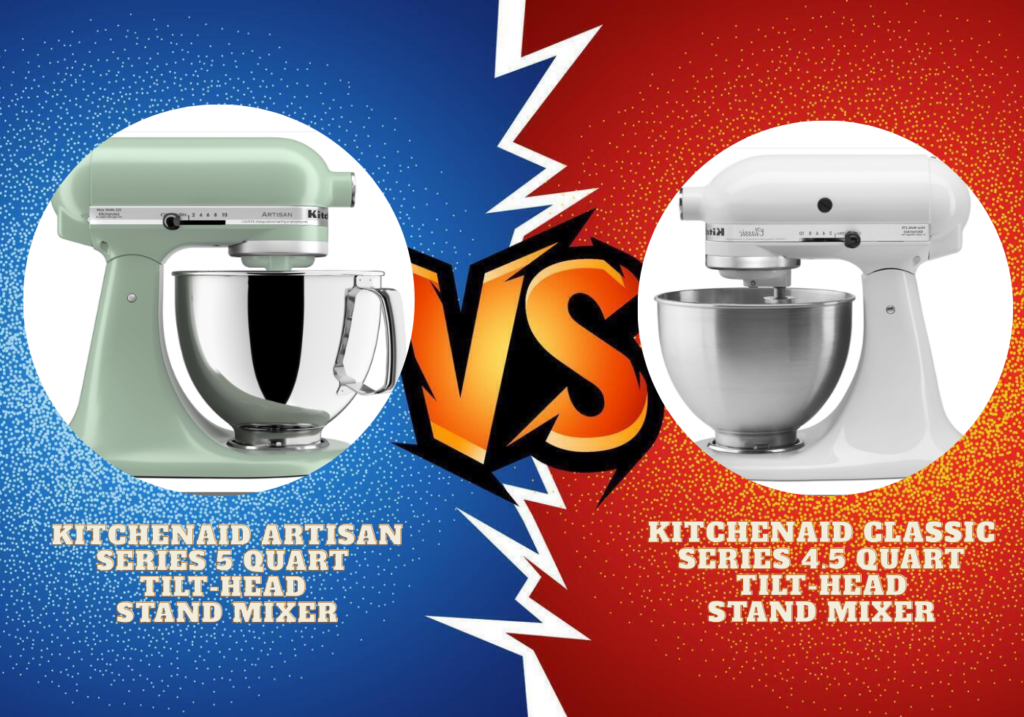
Quick Comparison: KitchenAid Artisan vs Classic Stand Mixer
| Feature | KitchenAid Artisan 5-Qt | KitchenAid Classic 4.5-Qt |
|---|---|---|
|
Typical Price Range
What most buyers usually pay online |
$350–$450 | $250–$330 |
|
Bowl Capacity
Total mixing capacity |
5 Quart stainless steel bowl | 4.5 Quart stainless steel bowl |
|
Motor Power
Raw mixing strength |
325W motor | 275W motor |
|
Speed Options
Control over mixing |
10 speeds | 10 speeds |
|
Mixing System
How ingredients are mixed |
Planetary mixing action | Planetary mixing action |
|
Cookie Batch Capacity
Maximum cookie dough capacity |
Up to 9 dozen cookies | Up to 8 dozen cookies |
|
Bread Dough Capability
Handling dense dough |
Handles occasional bread dough comfortably | Works for lighter dough batches |
|
Bowl Handle
Ease of lifting and pouring |
Yes, ergonomic handle | No handle |
|
Construction Quality
Materials and durability |
Die-cast metal body | Die-cast metal body |
|
Weight & Stability
How stable the mixer feels |
~22 lbs | ~21 lbs |
|
Attachments Included
Tools included in the box |
Flat beater, dough hook, whisk, pouring shield (varies) | Flat beater, dough hook, whisk |
|
Attachment Ecosystem
Extra accessories compatibility |
Full KitchenAid attachment system | Full KitchenAid attachment system |
|
Color Options
Available finishes |
Large range of colors | Limited color options |
|
Best For
Who the mixer suits best |
Frequent home bakers | Occasional baking |
|
Long-Term Durability
Reported by long-term users |
Very reliable over many years | Very reliable over many years |
|
Overall Value
General takeaway |
Best overall performance | Best budget KitchenAid |
|
Amazon
Check current price and reviews |
Check Price on Amazon | Check Price on Amazon |
Quick takeaway: The KitchenAid Classic is a solid entry-level stand mixer and works well for casual baking. The KitchenAid Artisan costs more, but the stronger motor, larger bowl, and extra features make it the more comfortable choice for frequent home bakers.
KitchenAid Artisan Series 5-Quart Stand Mixer
The KitchenAid Artisan is probably the stand mixer most people picture when they think of KitchenAid. It’s been one of the brand’s most popular mixers for years, and it shows up in a lot of home kitchens.
One thing that stood out to me while researching this mixer is how balanced it feels for everyday baking. It’s strong enough to mix cookie dough, cake batter, and even occasional bread dough without feeling like it’s struggling.

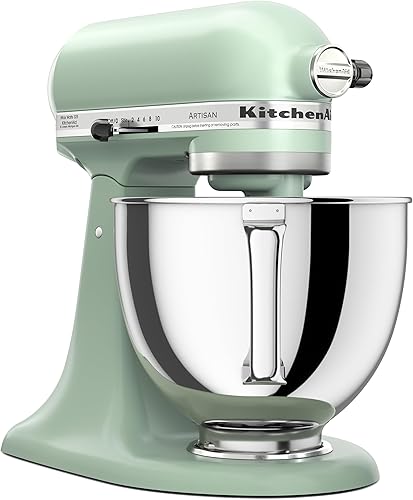
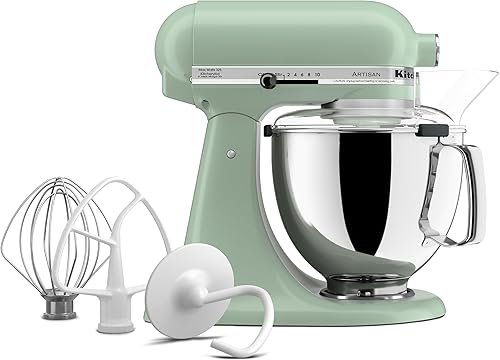
The 5-quart bowl is slightly larger than the Classic model. That difference doesn’t sound huge on paper, but in real use it means you can mix bigger batches. According to KitchenAid, the Artisan can handle around 9 dozen cookies in one batch, while the Classic usually handles around 8 dozen.
Another small but practical upgrade is the bowl handle. It makes lifting and pouring batter noticeably easier. If you’ve ever tried holding a heavy bowl full of dough, you’ll probably appreciate that detail.
Key Features
- 5-quart stainless steel bowl with handle
- 325-watt motor
- 10 mixing speeds
- Planetary mixing action
- Large range of color options
Pros
- Stronger motor than the Classic
- Larger mixing capacity
- Better for bread and thicker dough
- Wide selection of colors
Cons
- Costs noticeably more than the Classic
- Still not ideal for very heavy dough
⭐ Check Ratings & Customer Reviews
If you want a closer look at how this mixer performs in everyday baking — including dough mixing, real user feedback, and some of the small details people often overlook — you can read my full review of the KitchenAid Artisan stand mixer here.
In that guide I go deeper into the motor power, attachments, and long-term durability of the Artisan model, which uses a 325-watt motor and a 5-quart bowl designed to handle everything from cookie dough to bread recipes. :contentReference[oaicite:0]{index=0}
KitchenAid Classic Series 4.5-Quart Stand Mixer
The KitchenAid Classic is usually considered the entry-level KitchenAid mixer. It keeps the same core design but removes a few extras to bring the price down.
The bowl is slightly smaller at 4.5 quarts, and it doesn’t have a handle. That’s not a deal breaker, but it’s something people often notice when they start baking larger batches.
The motor is also a bit less powerful — about 275 watts compared to the Artisan’s 325 watts. In everyday baking you might not notice much difference, but it can show up when mixing thick cookie dough or kneading bread.
Still, many home bakers say the Classic works perfectly well for cakes, frosting, pancake batter, and occasional cookies. If you bake once in a while and mainly want a dependable mixer without spending too much, the Classic can make a lot of sense.
Key Features
- 4.5-quart stainless steel bowl
- 275-watt motor
- 10 speed settings
- Compatible with KitchenAid attachments
Pros
- More affordable than the Artisan
- Reliable performance for everyday recipes
- Same classic KitchenAid design
Cons
- Smaller bowl capacity
- Motor is slightly weaker
- No bowl handle
⭐ Check Ratings & Customer Reviews
If you’d like a closer look at how this mixer performs in everyday baking — including cookie dough, cake batter, and real user feedback — you can read my full review of the KitchenAid Classic stand mixer here.
In that review I go into more detail about the Classic model’s 275-watt motor, 4.5-quart bowl capacity, and what it’s actually like to use for typical home baking recipes.
KitchenAid Artisan vs Classic: Key Differences
1. Bowl Size
The Artisan uses a 5-quart bowl, while the Classic uses a 4.5-quart bowl. The difference sounds small, but it allows slightly larger batches and can make mixing easier when dough expands during kneading.
2. Motor Power
The Artisan’s 325-watt motor gives it a bit more strength for thicker doughs. The Classic’s 275-watt motor is still capable but may work harder during heavy mixing tasks.
3. Bowl Design
The Artisan bowl includes a handle, while the Classic bowl does not. It’s a small feature, but many users say it makes lifting batter or dough easier.
4. Color Options
The Classic usually comes in only a few colors. The Artisan, on the other hand, has dozens of finishes and limited-edition colors, which is one reason it’s often displayed on kitchen counters.
Common Questions When Comparing KitchenAid Artisan vs Classic Stand Mixer
Is the KitchenAid Artisan actually worth the extra cost compared to the Classic?
For many home bakers, the answer depends on how often the mixer will be used. The KitchenAid Artisan offers a slightly stronger motor and a larger 5-quart bowl, which can make mixing thicker dough and larger batches easier. If you bake frequently or like making cookies, bread, or pizza dough, the Artisan usually feels a bit more comfortable to work with. The KitchenAid Classic, however, still performs very well for everyday baking tasks like cakes, frosting, and occasional cookie batches.
How noticeable is the bowl size difference between the Artisan and the Classic?
The difference between a 5-quart bowl and a 4.5-quart bowl may not sound huge on paper, but some bakers do notice it in practice. The extra half-quart on the Artisan gives ingredients a little more room to move during mixing, which can help when working with larger cookie batches or thicker dough. For smaller recipes, though, both mixers perform very similarly.
Can both the KitchenAid Artisan and Classic mix bread dough?
Yes, both mixers can knead bread dough, but they handle it a little differently. The KitchenAid Classic can manage lighter doughs and occasional bread recipes without much trouble. The KitchenAid Artisan, thanks to its slightly stronger motor, tends to feel more comfortable with denser dough or frequent bread baking.
Do the KitchenAid Artisan and Classic support the same attachments?
They do. Both mixers include the standard KitchenAid power hub, which means they can use the same attachment ecosystem. Accessories like pasta rollers, meat grinders, food processors, and vegetable slicers work with either model, which is one reason many people stick with KitchenAid mixers.
Which mixer tends to last longer over time?
In terms of durability, both models have very similar reputations. They share the same general design and die-cast metal construction, and many owners report using their mixers for years without problems. In real-world use, the lifespan usually depends more on how heavily the mixer is used rather than whether it is the Artisan or the Classic model.
How the KitchenAid Artisan vs Classic Stand Mixer Can Actually Save Time in Everyday Baking
One thing I kept noticing while researching the KitchenAid Artisan vs Classic stand mixer is how often people say the same thing: once they start using a stand mixer, baking suddenly feels much easier.
Mixing by hand works, of course, but it can take a surprising amount of time and effort. Something simple like creaming butter and sugar for cookies might take several minutes with a wooden spoon or whisk. A stand mixer can usually do the same job faster and with less effort, while keeping the texture more consistent.
Both the Artisan and the Classic use KitchenAid’s planetary mixing action, which means the attachment rotates while moving around the bowl. In practice, that motion helps ingredients combine more evenly without needing constant scraping and stirring.
From what I’ve seen in reviews, a lot of home bakers appreciate the hands-free aspect just as much as the mixing power. While the mixer is running, you can measure the next ingredients, prep baking pans, or clean up a little. It sounds like a small thing, but when you’re baking multiple recipes, those little time savings really add up.
The slightly stronger motor and larger bowl on the Artisan can also make mixing large batches feel a bit easier. But even the Classic model still handles everyday tasks like cake batter, frosting, and cookie dough without much trouble. For many kitchens, either mixer ends up becoming one of the most used appliances on the counter.
Common Questions People Have About KitchenAid Artisan vs Classic Stand Mixer
Is the KitchenAid Artisan really better than the Classic?
In many cases, yes — but it depends on how often you bake. The Artisan has a slightly stronger motor and a larger bowl, which can make mixing thicker dough or bigger batches easier. If you bake frequently, those small upgrades can be noticeable.
Is the KitchenAid Classic good enough for most home bakers?
For many people, it absolutely is. If you’re mostly making cakes, cookies, frosting, or pancake batter, the Classic handles those recipes comfortably. A lot of owners say it works perfectly well for occasional baking.
Does the extra half-quart on the Artisan bowl really matter?
It might not seem like much, but some bakers do notice the difference. A slightly larger bowl gives ingredients more room to move while mixing, especially when working with larger cookie batches or bread dough.
Do both mixers work with KitchenAid attachments?
Yes. Both the Artisan and Classic models use the same KitchenAid power hub, so attachments like pasta rollers, meat grinders, and vegetable slicers can be used with either mixer.
Which mixer do most people end up choosing?
From what I’ve seen while reading reviews, the Artisan tends to be the more popular choice if the price difference isn’t a big concern. But plenty of people still choose the Classic because it delivers the same KitchenAid experience at a lower cost.
KitchenAid Artisan vs Classic Stand Mixer – Which One Feels Right in a Real Home Kitchen?
After spending quite a bit of time comparing the KitchenAid Artisan vs Classic stand mixer, reading through hundreds of user reviews, and looking closely at the specs, the truth is that both mixers are genuinely good choices. They share the same core KitchenAid design, the same tilt-head style, and the same reliable mixing system that home bakers have trusted for years.
The difference really comes down to how often you bake and how much power or capacity you might need. If you bake regularly — things like cookies, bread dough, or larger batches of batter — the KitchenAid Artisan tends to feel like the more comfortable option. The slightly stronger motor and the 5-quart bowl simply give it a little more breathing room when the mixing gets heavier.
On the other hand, the KitchenAid Classic still does a great job for everyday baking. Many people buy it as their first stand mixer, and for recipes like cake batter, frosting, muffins, or occasional cookie batches, it usually performs perfectly well. It keeps the same sturdy metal build and the same mixing system — just with a slightly smaller bowl and motor.
One thing that really stood out to me while researching these mixers is how many long-time owners say the same thing: once you get used to baking with a stand mixer, it becomes one of the most used tools in the kitchen. That seems to be true whether someone buys the Classic or the Artisan.
If you’re curious about the official specifications, attachments, and product details, you can also explore the full mixer lineup directly on the KitchenAid website, which shows how these models fit into the broader KitchenAid mixer family.
So if you’re trying to choose between the two, a simple rule of thumb usually works well:
- Choose the KitchenAid Artisan if you bake often, make bread occasionally, or want a little extra power and bowl capacity.
- Choose the KitchenAid Classic if you bake occasionally and want a dependable KitchenAid mixer at a more affordable price.
Either way, you’re still getting the same classic stand mixer design that has been sitting on kitchen counters for decades. And for many home bakers, that’s exactly the reason these mixers keep showing up in so many kitchens.
