KitchenAid Artisan tilt-head stand mixer is one of those appliances people often decide they want long before they actually need one.
It shows up in wedding registries, kitchen makeovers, and “dream kitchen” Pinterest boards. It looks solid, familiar, almost iconic. And because of that, a lot of people walk into the purchase with a very specific set of expectations—some realistic, some not.
The interesting part isn’t whether the mixer is good. It is. The more useful question is where expectations start to drift away from reality. Because most of the disappointment you see around this mixer doesn’t come from what it is—it comes from what people assume it should be.
Here are the most common things buyers tend to get wrong.

1. It’s Not a Heavy-Duty Bread Machine (Even If People Treat It Like One)
One of the biggest misconceptions is that the Artisan is built for frequent, heavy bread baking.
It can make bread. That part is true. But that doesn’t mean it’s designed for repeated dense dough sessions week after week.
The tilt-head design and motor are perfectly fine for occasional dough—pizza, soft sandwich bread, maybe the occasional batch of rolls. But once you start pushing into dense, low-hydration dough or long kneading sessions, the mixer starts to feel like it’s working harder than it wants to.
This is where a lot of frustration comes from. People expect “stand mixer” to automatically mean “handles everything.” But KitchenAid’s own lineup separates tilt-head models like the Artisan from bowl-lift models for a reason.
The Artisan is more of a general-purpose mixer. When you treat it like a bread-focused machine, it doesn’t fail—but it stops feeling comfortable.
2. The 5-Quart Bowl Sounds Bigger Than It Feels
On paper, 5 quarts sounds generous. In real use, it’s more moderate than people expect.
For most recipes, it works fine. Standard cake batter, cookies, frosting—it’s enough. But when people start doubling recipes or trying to mix larger batches, the bowl fills up quickly.
There’s also the shape to consider. It’s not just about volume—it’s about how ingredients move inside that space. Once you get close to the upper limit, things start to feel crowded, and mixing becomes less efficient.
This is especially noticeable with dough. Even if it technically fits, it doesn’t always feel like the mixer has enough room to handle it comfortably.
The expectation is “big enough for anything.” The reality is “big enough for most normal baking.” That’s a subtle but important difference.
3. The Iconic Look Doesn’t Mean It’s the Most Powerful Option

KitchenAid Artisan 5-Qt. Stainless Steel Bowl with comfortable handle Stand Mixer with Pouring Shield
The KitchenAid Artisan tilt-head stand mixer has a certain presence. It looks solid. Heavy. Durable. Almost industrial.
But that look can be misleading.
It’s not the most powerful mixer in its category. Not even close in some cases.
There are mixers with stronger motors, more aggressive mixing action, and better performance under heavy loads. The Artisan isn’t trying to win on raw power. It’s trying to balance usability, design, and everyday performance.
People sometimes assume they’re getting a “professional-level” machine because of how it looks. What they’re actually getting is a very well-designed home mixer that prioritizes versatility over brute strength.
That’s not a flaw. But it does matter if your expectations are built around performance rather than usability.
4. Attachments Sound Amazing… But Most People Barely Use Them
The attachment ecosystem is one of KitchenAid’s biggest selling points.
Pasta rollers, meat grinders, food processors—it all sounds impressive. And for some people, it genuinely is.
But here’s what often happens in practice: most buyers end up using maybe one or two attachments, if any at all.
The mixer becomes a mixer again.
That doesn’t mean the attachment system is useless. It just means it’s often overvalued during the buying decision. People imagine a multi-function kitchen hub. What they actually use is a reliable tool for mixing.
If you already know you’ll use attachments, great. If not, they shouldn’t be the main reason you choose this mixer.
5. It’s Not Maintenance-Free (Even If It Feels Like It Should Be)

Includes coated flat beater, coated dough hook, 6-wire whip and 1-piece pouring shield
Because of the brand and reputation, some people assume the Artisan is a “buy it once, forget about it” kind of appliance.
And to some extent, that’s true. It’s generally durable and well-built.
But it’s still a machine with moving parts.
Over time, you may notice small things:
- ingredients sticking to the sides of the bowl
- needing to scrape more often than expected
- slight adjustments to how attachments sit in the bowl
None of these are major issues. But they’re part of the ownership experience. And they surprise people who expect a completely hands-off tool.
The Artisan is reliable—but it’s not magic.
6. You Don’t Actually Need One as Much as You Think
This one is a little uncomfortable, but it’s probably the most honest point.
A lot of people want a KitchenAid Artisan tilt-head stand mixer before they really have a clear need for it.
And that’s understandable. It’s one of those products that feels like a milestone in a kitchen. Like you’ve “leveled up.”
But in everyday cooking, many of the tasks it handles can still be done by hand or with simpler tools.
That doesn’t make it unnecessary. It just means its value depends heavily on how often you actually use it.
For someone who bakes regularly, it becomes a time-saver and a convenience tool. For someone who bakes occasionally, it can end up sitting unused more often than expected.
7. It’s Not Really About Performance—It’s About Balance
This is probably the biggest misunderstanding of all.
The Artisan isn’t trying to be the best at any single thing.
It’s trying to be good at many things, while also being approachable, familiar, and easy to live with.
That balance is what makes it popular. But it also means it won’t dominate in any one category.
If you want the strongest mixer, there are stronger ones. If you want the largest capacity, there are bigger ones. If you want the cheapest option, there are more affordable ones.
The Artisan sits somewhere in the middle of all those decisions.
So What Should You Expect Instead?
If you reset your expectations, the KitchenAid Artisan tilt-head stand mixer makes a lot more sense.
Think of it as:
- a reliable everyday mixer
- something that handles most baking tasks comfortably
- a tool that feels easy to use and easy to keep around
- not a specialist machine for extreme workloads
When you frame it that way, a lot of the “disappointments” disappear—because they were based on the wrong expectations to begin with.
The Color Question Is More Important Than It Sounds
With most stand mixers, color is just a side detail. With the KitchenAid Artisan tilt-head stand mixer, it is part of the reason people want it in the first place.
That may sound superficial, but I do not think it really is. This is one of the few mixers people fully expect to leave out on the counter, which means the color ends up becoming part of the kitchen in a way that other appliances usually do not. It is not just about matching cabinets or choosing something “pretty.” It is about whether the mixer feels like it belongs in the room enough to stay visible and actually get used.
That also helps explain why people can get strangely attached to specific shades. With KitchenAid, the finish is part of the emotional pull. Someone may start out thinking they are choosing between mixers, and then realize they are also choosing between a softer neutral, a brighter statement color, or a classic finish that feels safer long term.
The practical side of this is pretty simple: if you are going to spend this much on a mixer and keep it on display, you should probably choose a color you will still like in a few years, not just one that looks exciting in the moment. The Artisan is one of those appliances where color genuinely affects satisfaction more than people like to admit.
Price: You Are Not Just Paying for Mixing Power
The price of the KitchenAid Artisan tilt-head stand mixer is another place where expectations can get a little mixed up.
People sometimes look at the price and assume they are paying for top-tier performance alone. I do not think that is really what is happening. Part of the cost is absolutely the mixer itself, but part of it is also the brand trust, the design, the finish, the attachment ecosystem, and the fact that this is one of the few stand mixers that has become a kind of long-term “want” item for home cooks.
That means the Artisan can look overpriced if you judge it purely on motor strength or dough performance. And honestly, in some cases, that criticism is fair. There are mixers that make a stronger case on raw performance for the money.
But that is not the whole story either. The Artisan tends to hold its value better in people’s minds because it feels like a purchase they plan to live with for a long time, not just a tool they grabbed because it was cheap. Whether that feels reasonable or not really depends on what matters more to you. If you only care about function, the price may feel a little inflated. If you care about daily use, design, familiarity, and the overall ownership experience, the number starts to make more sense.
So the real question is not whether it is cheap, because it is not. The question is whether you are comfortable paying for more than just mixing performance. With the Artisan, that is a big part of what the price includes.
The Hidden Risk: What Happens When Something Small Breaks
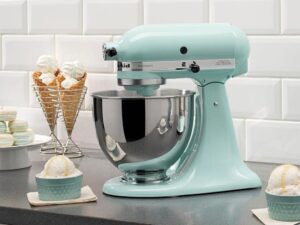
Over 20 colors available.
There’s one detail that doesn’t show up in product listings, and honestly, it matters more than most specs.
It’s not about how the mixer works when everything is fine. It’s about what happens when one small part stops working.
Going through long-term user feedback, a pattern shows up pretty quickly. A lot of people don’t complain about the mixer right away. They complain later—when a whisk breaks, a bowl cracks, or a small piece wears out faster than expected. :contentReference[oaicite:0]{index=0}
And the frustration isn’t just that something failed. It’s what comes next.
Several owners mentioned the same issue: finding replacement parts is surprisingly difficult. Not just inconvenient—actually difficult. In some cases, people couldn’t find a compatible whisk, an extra bowl, or even a simple attachment that should normally be easy to replace. :contentReference[oaicite:1]{index=1}
That changes how the mixer feels as a purchase.
Because with most well-established mixer brands, there’s an assumption in the background: if something wears out, you can replace it. You can buy a new whisk. You can get another bowl. The machine keeps going.
Here, that assumption feels less certain.
And once you realize that, you start thinking about the mixer differently. Not just as a tool you’ll use today, but as something that may or may not be easy to maintain a year from now.
For some buyers, that won’t matter much. If you bake lightly and just want something that looks good and works for everyday tasks, you may never run into that problem.
But if you’re the kind of person who expects to keep a mixer for years—and replace small parts along the way—it’s worth thinking about before you buy, not after.
Because in the long run, the most important part of a stand mixer isn’t the motor. It’s whether you can keep using it when the first small thing goes wrong.
Looking at Other Artisan Options Before You Decide
If you’re considering the KitchenAid Artisan tilt-head stand mixer, it’s worth taking a minute to look at how it compares to a couple of closely related options within the same lineup.
The smaller version, for example, tends to appeal to people who like the Artisan style but do not need the full 5-quart capacity. This KitchenAid Artisan Mini review gives a clearer picture of what you gain in compactness—and what you give up in capacity and overall mixing room.
On the other side, if you want a more traditional breakdown of the standard model—how it performs, where it fits, and what to expect from it as a general-purpose mixer—this KitchenAid Artisan stand mixer review takes a more straightforward approach.
Looking at both angles can help ground your expectations a bit. The Artisan line isn’t just one product—it’s a range of slightly different trade-offs around size, weight, and everyday usability. Seeing how those differences play out makes it easier to decide whether the tilt-head version actually matches the way you cook.
One Last Thought
The KitchenAid Artisan tilt-head stand mixer isn’t misunderstood because it’s flawed. It’s misunderstood because it’s so familiar.
People assume they already know what it is before they’ve actually used it.
In reality, it’s a very specific kind of tool: not the most powerful, not the largest, not the most specialized—but one that fits comfortably into a lot of kitchens without demanding too much from the person using it.
And once you see it that way, it becomes easier to decide whether it actually belongs in yours.
