If you’re staring at the KitchenAid 5.5 Quart Bowl-Lift Stand Mixer and the 7 Quart version wondering which one to bring home, you’re not alone. Both feel like a serious upgrade from the everyday tilt-head Artisan most of us start with. They sit rock-solid on the counter thanks to that bowl-lift design—no more head flopping back while you’re fighting stiff dough.
Here’s the honest take: these two mixers are mechanically almost identical. Same motor guts, same 11 speeds (including that handy half-speed for gentle folding), same planetary mixing that actually scrapes the bowl decently. The real difference boils down to that extra 1.5 quarts of bowl space and how it changes your actual baking days.
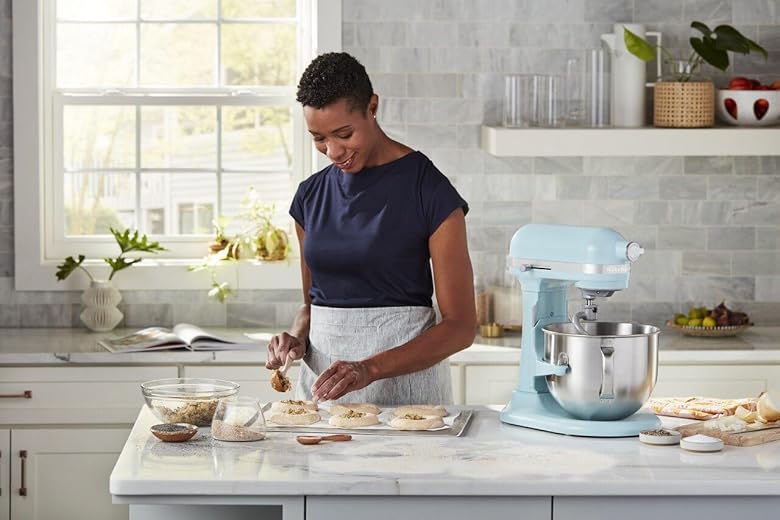
What They Both Do Really Well
These bowl-lift models deliver noticeably more stability and power than a standard 5-quart tilt-head. Users constantly say the machine barely budges even when tackling double batches of cookie dough or heavy bread. The half-speed setting is legitimately useful—I’ve seen multiple people mention it saves them from deflating egg whites or crushing delicate berries when folding in mix-ins.
They handle the full lineup of KitchenAid attachments, so once you start adding the grinder or pasta roller, it all clicks together nicely. And yeah, they feel built to last. Die-cast metal body, stainless bowl, that solid crank to lift the bowl into place. A lot of long-time owners report these running reliably for years as long as you don’t abuse the higher speeds with super stiff dough.
Where the Bowl Size Actually Matters in Real Life
The 5.5-quart model claims around 11 dozen cookies, over 7 pounds of bread dough, or a solid 6 pounds of mashed potatoes. The 7-quart pushes that to about 13 dozen cookies, 8.5+ pounds of bread, and closer to 7.5 pounds of spuds. On paper it doesn’t sound huge, but it shows up in practice.
With the 5.5-quart, most weekend bakers feel plenty comfortable. A double batch of chocolate chip cookies fits without drama, and you can still whip a small amount of cream or a couple egg whites without everything pooling uselessly at the bottom. Wirecutter testers liked it better than the older 6-quart Pro for exactly this reason—it needs less constant scraping on smaller jobs while still powering through bigger ones.
The 7-quart shines when you’re in full holiday mode or baking for a crowd. One Reddit user talked about cranking out 15 kinds of cookie dough in one session without splitting batches constantly. Bread makers who do multiple loaves or big brioche runs appreciate the extra headroom—less worry about ingredients climbing the hook or spilling over the sides.
Here’s the catch though: for everyday small tasks, the bigger bowl can feel a bit wasteful. Ingredients sometimes get lost down there, and you end up scraping more than you’d like. Several people mentioned the 5.5-quart just feels more versatile for normal family baking.
If bread is the main reason you’re shopping for a stand mixer, this guide to the best stand mixer for bread dough gives a broader look at which models really make sense once you start working with heavier batches regularly.
Build Quality, Weight, and the Annoying Little Things
Both are heavy beasts—around 30-35 pounds fully assembled. Most owners end up leaving them on the counter permanently because lugging either one around gets old fast. The 7-quart edges a bit heavier due to the larger bowl, but the footprint stays almost the same.
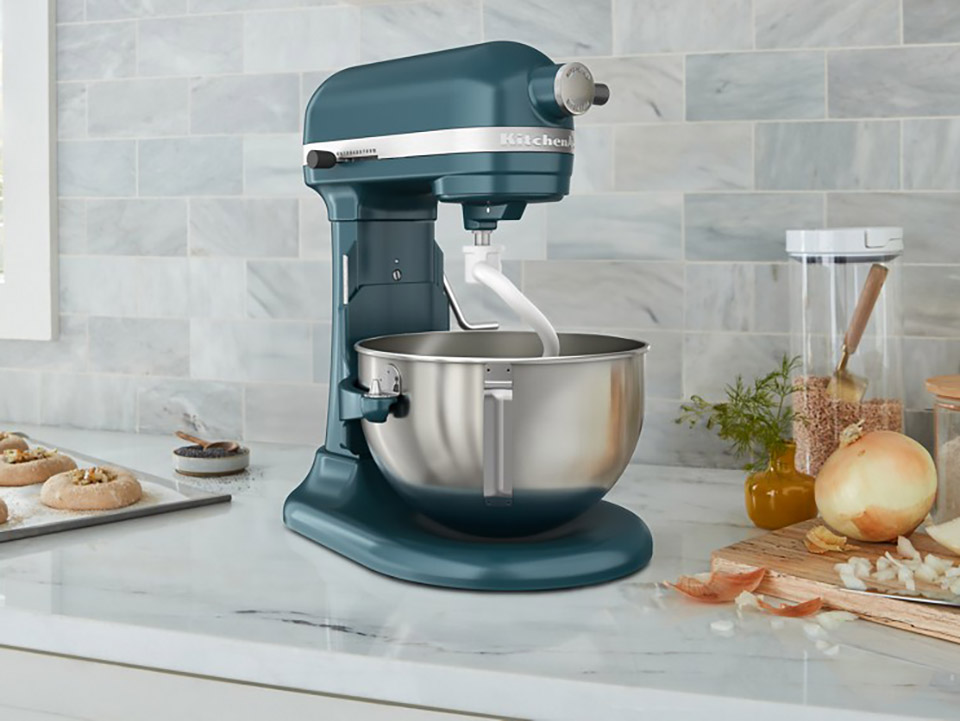
KitchenAid 5.5 Quart Bowl-Lift Stand Mixer vs 7 Quart
Durability is mostly solid, but not perfect. The coated flat beater and dough hook can chip pretty quickly—I’ve seen multiple complaints about this happening on the very first big cookie batch. A bunch of people immediately order a stainless steel replacement beater and call it a day. Some folks have reported the motor smoking or leaking a little grease when pushed hard with really stiff dough at higher speeds. KitchenAid suggests staying on speed 2 or lower with the dough hook for heavy kneading, which feels like a reasonable heads-up.
The nylon gears can eventually wear out after years of serious use, though newer models seem a bit improved. Noise-wise, they’re quieter than many older Pro models, especially the 5.5-quart according to recent tests. Still, don’t expect library silence when it’s working through thick dough.
Cleaning is straightforward enough—bowls and most attachments go in the dishwasher, though hand-washing the coated parts might help them last longer. Flour has a way of sneaking into crevices, so a quick wipe-down after messy sessions prevents buildup.
Who Should Actually Buy the 5.5 Quart
If your baking is serious but not industrial—weekend cookies for the kids’ events, a couple loaves of bread here and there, the occasional big cake—this one often hits the sweet spot. It gives you real power and stability without feeling oversized for daily use. People upgrading from a struggling Artisan frequently say it feels like the right next step without overkill.
Skip it if you mostly do tiny single batches or need something you can easily tuck away. In those cases, a good tilt-head might still serve you better and save some counter real estate (and money).
When the 7 Quart Starts to Feel Worth It
Go bigger if you regularly bake in bulk: holiday cookie platters, weekly sourdough for a big family, or prepping dough to freeze. The extra space reduces frustration on those days, and the taller sides help contain splatter better. Serious bread enthusiasts who hate splitting recipes tend to love it.
But be honest with yourself. If most of your recipes stay modest, that extra capacity just sits there looking impressive while you still scrape the bottom the same amount. Plus you’re paying more—sometimes $100-200 extra depending on sales and colors—and dealing with a slightly heavier machine.
I ended up digging deeper into the bigger model, and if you’re curious how it actually handles heavy dough and large batches, the full KitchenAid® 7 Quart Bowl-Lift Stand Mixer review breaks that down in a lot more detail.
| Feature | KitchenAid 5.5 Quart Bowl-Lift | KitchenAid 7 Quart Bowl-Lift |
|---|---|---|
|
Bowl Capacity
Stated mixing bowl size and typical batch claims |
5.5 quarts (about 11 dozen cookies, 7+ lbs bread dough) | 7 quarts (about 13 dozen cookies, 8.5+ lbs bread dough) |
|
Motor & Power Delivery
Claimed performance relative to tilt-head models |
~500W, solid power boost for home use | ~500W, same core motor with more room for big loads |
|
Speeds
Including any special low settings |
11 speeds with ½ speed for folding | 11 speeds with ½ speed for folding |
|
Weight & Footprint
How much space and effort to move it |
Heavy (~30+ lbs), stays on counter | Slightly heavier (~34-35 lbs), same basic footprint |
|
Best For
Typical user scenarios from real owners |
Most serious home bakers, balanced everyday use | Bulk baking, holidays, frequent large batches |
|
Common Trade-off
What actually frustrates users |
Great all-rounder but can need extra scraping on tiny jobs | Excellent capacity but feels oversized (and heavier) for daily small tasks |
|
Check Price
Quick links for the two KitchenAid stand mixer sizes. |
Check Price on KitchenAid | Check Price on Amazon |
Most owners end up saying the 5.5-quart gives the best everyday balance. The 7-quart only really pays off when you consistently need that extra volume.


If You’re Still On the Fence: What You Really Need to Figure Out Before Buying
When people are stuck between the 5.5 Quart and 7 Quart KitchenAid bowl-lift mixers, they usually ask the same things I see over and over in reviews and forums. Here’s what actually helps most people decide without overthinking it.
First, grab your most-used recipes and do a quick reality check: how often do you double or triple batches? If you’re mostly making one batch of cookies for the family, whipping cream for two people, or kneading dough for a couple of loaves, the 5.5-quart is honestly plenty—and it feels less awkward on smaller jobs. A lot of owners say the bigger bowl makes small amounts “disappear” at the bottom, so you end up scraping more than you want.
But if you regularly bake for holidays, make cookie platters for gifts, prep big batches of sourdough to freeze, or cook for a large family, that extra 1.5 quarts in the 7-quart model starts to feel like a real time-saver. You won’t have to split dough as often, and there’s less risk of overflow when you add chunky mix-ins.
Another big one: counter space and commitment. Both machines are heavy (30+ pounds) and most people leave them out permanently. The 7-quart is just a bit taller and heavier, so measure your spot. If you think you might want to move it sometimes, the 5.5-quart is slightly more manageable.
Price difference matters too— the 5.5-quart is often $100–$200 cheaper depending on sales and colors. That money could go toward a stainless steel beater or extra attachments instead.
Good news for the undecided: recent bowl-lift models let you swap bowls pretty easily. Many people buy the cheaper 5.5-quart now and later add a 7-quart bowl if their baking grows. It’s not a perfect long-term fix (the beater and dough hook that come with the bigger bowl work better in it), but it gives you flexibility without buying a whole new machine.
Bottom line? Be brutally honest about your actual baking habits, not the “someday I’ll bake like a pro” version. Most everyday serious bakers end up happier with the 5.5-quart because it’s the better all-rounder. The 7-quart only feels worth the extra cost and weight when big batches become your normal routine.
Do You Actually Need the 5.5 Quart Bowl-Lift — or Would a Tilt-Head Be Enough?
This is the part most people don’t think through carefully.
Once you start looking at the KitchenAid 5.5 quart bowl-lift stand mixer, it’s easy to assume you need that level of machine. It looks more “serious,” more powerful, and closer to what experienced bakers use. But the real question is whether your baking actually demands that jump.
Because in many home kitchens, a good tilt-head mixer already covers a surprising amount of ground.
A typical 5-quart tilt-head like the Artisan can handle around 8 to 9 dozen cookies in one batch and has enough power for most everyday recipes, from cake batters to moderate bread doughs :contentReference[oaicite:0]{index=0}. For casual baking, that’s already more than enough capacity and performance.
If your routine looks like weekend cookies, birthday cakes, whipped cream, and the occasional loaf of bread, a tilt-head often feels easier to live with. It’s lighter, takes up less vertical space, and is simply more convenient to use day-to-day. That’s exactly why models like the KitchenAid Artisan stand mixer are still the most popular choice for home bakers.
Where the 5.5-quart bowl-lift starts to justify itself is when your mixing gets heavier or more frequent.
Bowl-lift mixers are built for stability and power, especially when dealing with dense doughs or larger batches. The fixed head and 3-point locking bowl design help keep things steady under load, which becomes noticeable when you’re kneading bread regularly or working with thick mixtures :contentReference[oaicite:1]{index=1}.
So the decision isn’t really about 5.5 qt vs 7 qt yet — it’s about whether you even need to step into bowl-lift territory at all.
If you bake occasionally and rarely push your mixer hard, a tilt-head will feel more practical and easier to use most of the time. But if you already know you’ll be making bread often, doubling recipes, or working with heavier doughs, the 5.5-quart bowl-lift becomes a meaningful upgrade rather than an unnecessary one.
And only after that decision is clear does it make sense to ask the next question: if you’re already going bowl-lift, should you size up to the 7-quart?
One Last Honest Take
Both the KitchenAid 5.5 Quart Bowl-Lift Stand Mixer and the 7 Quart are capable machines that’ll handle way more than most cheap mixers ever could. The internals are so similar that many people on forums treat them like the same mixer with different bowls—and you can actually swap bowls between recent models if you want to upgrade capacity later.
If I were picking for my own kitchen and my baking stays mostly family-sized with occasional bigger projects, I’d lean toward the 5.5-quart. It feels practical without the extra bulk or cost. But if you’re the person who regularly turns out dozens of cookies for gifts or multiple loaves every week, the 7-quart will probably make those days noticeably less annoying.
Bottom line: look hard at your actual recipes and how often you double or triple them. That mental math usually makes the choice pretty clear. Whichever you go with, plan on it living on the counter—it’s too much machine to hide away easily. And seriously consider grabbing a stainless flat beater right away if the coated one that comes with it bugs you (it bugs a lot of people).
Check current prices and colors because sales pop up. For most people, the 5.5-quart ends up being the smarter everyday pick. Either way, you’ll wonder how you ever mixed heavy dough by hand again.
