The Kitchen in the Box stand mixer shows up quite often when people start looking into stand mixers online. It appears in Amazon searches, beginner baking guides, and many recommendations aimed at smaller kitchens. Part of the reason is easy to understand. The mixer is compact, the price is usually fairly approachable, and the color options feel noticeably brighter than the typical budget appliances that tend to come only in black, gray, or stainless steel.
At KitchenDict, this mixer has already been discussed once from a more critical perspective. My colleague, Chef Anthony Russo, shared a fairly skeptical view of the product in an earlier review. I understand where some of that criticism comes from. Compared with larger or more established stand mixers, the Kitchen in the Box model clearly has limitations.
That said, my perspective is a little different. As someone who cooks and bakes mostly in a normal home kitchen rather than a restaurant environment, I try to judge appliances based on how they actually fit into everyday routines. A mixer does not always have to be powerful enough for bakery-level dough to be useful.
So instead of repeating the same arguments, I wanted to approach this mixer from another angle. This article is not meant to defend the product or criticize it outright. Rather, the goal is to explain what the Kitchen in the Box stand mixer actually is, where it fits in the market, and what buyers should realistically expect before purchasing one.

Kitchen in the box Stand Mixer,3.2Qt,6 Speeds
First, what kind of brand is Kitchen in the Box?
Kitchen in the Box is not one of the traditional stand mixer brands that most people recognize immediately. It does not have the decades-long reputation of companies like KitchenAid, nor does it focus exclusively on mixers. Instead, it belongs more to the category of modern kitchen gadget brands that sell a variety of compact appliances aimed at home cooks.
That does not automatically make the products bad. Many newer brands focus on affordability and convenience rather than legacy reputation. But it does mean buyers should approach the mixer with a slightly different mindset. You are not buying into a long-standing professional appliance line. You are buying a compact appliance designed primarily for everyday home use.
In my experience, understanding that context helps set expectations much more accurately.
Main features and highlights of the Kitchen in the Box stand mixer
Before getting into opinions or comparisons, it helps to look at what this mixer actually offers on paper. The Kitchen in the Box stand mixer is designed as a compact, beginner-friendly appliance, and most of its features reflect that goal. It focuses on keeping the machine small, simple to use, and affordable while still covering the basic tasks people expect from a stand mixer.

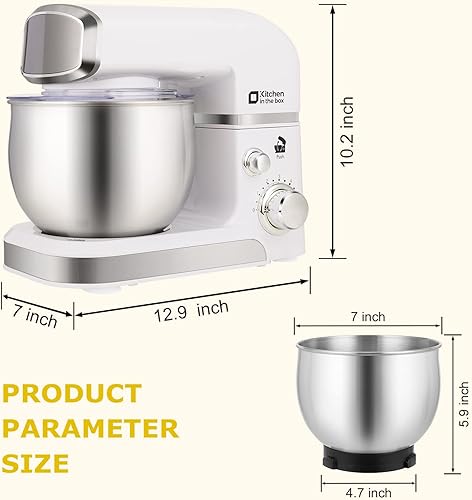

- Compact and lightweight design
The mixer weighs under 7 pounds and measures roughly 12.9 × 7 × 10.2 inches. That makes it noticeably smaller than many traditional stand mixers. In practical terms, this means it is easier to move around, easier to store in cabinets, and much more manageable for smaller kitchens or apartments where counter space is limited. - 3.2-quart stainless steel bowl
The mixer comes with a 3.2-quart stainless steel mixing bowl, which is sized more for everyday home baking than large batch preparation. It works well for cakes, cookies, frosting, whipped cream, and other small to medium recipes. For couples or small households, this size is usually perfectly adequate. - Tilt-head design
Like many classic stand mixers, the head tilts upward to make it easier to install or remove the bowl and attachments. This also makes cleaning simpler and gives better access when adding ingredients during mixing. - Six speed settings
The mixer includes six different speed levels, allowing it to handle a range of tasks from gentle stirring to faster whipping. Lower speeds are useful for folding ingredients together, while the higher speeds help with whipping cream, beating eggs, or mixing lighter batters. - Multiple mixing attachments included
The package typically includes three core attachments: an aluminum dough hook, a flat beater, and a stainless steel whisk. Together, these cover most everyday baking needs—from kneading basic dough to mixing batter and whipping lighter mixtures. - Anti-slip suction feet
Four suction cups on the bottom help stabilize the mixer during operation. This helps reduce movement on the counter while mixing, especially when working with thicker batters or doughs. - Transparent anti-splash lid
The included splash guard helps reduce ingredient mess when adding flour or other dry ingredients while the mixer is running. It is a small feature, but it can make the process noticeably cleaner. - Wide color selection
Unlike many budget mixers that only come in a couple of neutral colors, this model is often available in a surprisingly large range of shades. From soft pastel tones to brighter colors, buyers can choose something that fits their kitchen style a little better. - Very affordable price point
Perhaps the biggest highlight is simply the cost. The mixer often sells around the $60–$70 range, which is dramatically cheaper than many well-known stand mixers. For buyers who are just getting started with baking, that lower price can make the idea of owning a stand mixer much more accessible.
None of these features alone make the mixer extraordinary. But when combined, they explain why the product attracts attention: it offers a fairly complete set of basic stand-mixer capabilities in a small, colorful, and inexpensive package.
Why this mixer gets so much attention online
The Kitchen in the Box stand mixer attracts attention for several fairly obvious reasons. First, it is usually cheaper than many well-known mixers. For people who are just starting to bake, that lower entry price can make the idea of owning a stand mixer much more approachable.
Second, the design is compact. Not every kitchen has space for a large, heavy appliance sitting permanently on the counter. In apartments, smaller homes, or busy family kitchens where counter space is limited, a lighter mixer can actually be easier to live with.
The third factor is appearance. Kitchen in the Box mixers often come in bright or pastel colors that feel modern and playful. That may sound superficial, but visual design genuinely matters in home kitchens. If an appliance looks friendly and not overly industrial, people are often more comfortable using it regularly.
Put those three things together—price, size, and appearance—and it becomes easy to see why the mixer catches people’s attention.
A surprisingly fun range of colors for a budget mixer
One thing that immediately stands out about the Kitchen in the Box stand mixer is how many color options it comes in. Most budget stand mixers tend to stick to a fairly predictable palette—usually black, silver, or maybe one or two brighter options. This one goes a little further. Depending on the listing, you will often see several colors available at the same time, from pastel tones like mint green or soft pink to brighter shades like red or blue.
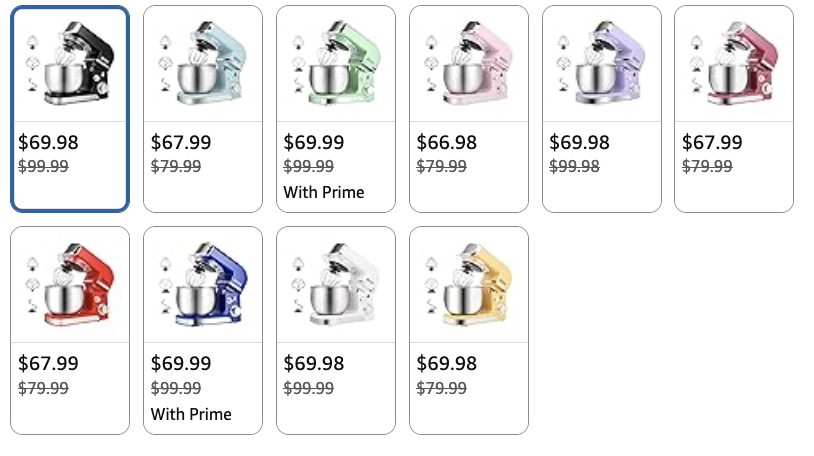
Kitchen in the Box Stand Mixer – range of colors
That may not sound like a major feature, but in a real home kitchen it actually matters more than people sometimes admit. Many mixers end up sitting on the counter rather than being stored away after every use. Having a color that feels a little more personal—or simply looks nice in the kitchen—can make the appliance feel less like a piece of equipment and more like part of the space.
The compact size of the mixer also helps here. At under seven pounds and roughly the size of a small countertop appliance, it does not dominate the counter the way larger stand mixers sometimes do. For apartments, smaller kitchens, or homes where storage space is limited, that lighter footprint can be genuinely practical.
And honestly, the price makes the whole thing a little easier to appreciate. Stand mixers in this size and price range usually do not offer this many visual choices. When you combine the compact design, the 3.2-quart bowl, multiple speeds, and the included attachments, it is hard not to notice that the mixer offers quite a bit for a product that often sells in the $60–$70 range.
That does not automatically mean it competes with larger, more powerful mixers. But within its category—small, beginner-friendly stand mixers—the overall package does feel surprisingly generous for the price.

Upgraded Multi Attachments – Aluminium dough hook and flat beater,stainless steel whisk
The most important thing buyers should understand
The biggest mistake some buyers make with the Kitchen in the Box stand mixer is expecting it to behave like a larger, heavier-duty machine. A product page may mention bowl capacity or motor wattage, but those numbers alone do not always tell the full story about real-world performance.
In practical terms, this mixer belongs more naturally in the compact, light-duty category. It is designed for everyday baking tasks rather than demanding workloads.
That means it can handle many typical home baking jobs quite comfortably. Mixing cake batter, whipping cream, preparing frosting, or blending cookie dough are all things it should manage without much difficulty.
Where expectations should remain realistic is with dense bread dough, very large batches, or extremely frequent use. Those kinds of tasks usually benefit from a heavier mixer with stronger internal components.
This distinction is important because many buyers assume all stand mixers behave similarly. In reality, there is a wide spectrum between compact beginner mixers and more powerful machines designed for heavier kitchen work.
Where this mixer can work well
In a typical home kitchen, many baking tasks are actually fairly light. Not everyone is kneading bread dough every weekend or preparing large commercial-style batches.
For that kind of everyday cooking, a smaller mixer can be perfectly practical.
- Cake batters and cupcake mixes
- Cookie dough for normal batch sizes
- Whipped cream and frostings
- Pancake or waffle batter
- Mashed potatoes and similar mixtures
These are exactly the kinds of jobs many home cooks make most often. When used in this way, a compact stand mixer can be a convenient helper rather than an oversized appliance that rarely leaves the cabinet.
What the customer reviews actually tell us
The Kitchen in the Box stand mixer currently holds an average rating of about 4.4 out of 5 stars based on more than 8,700 global reviews. At first glance, that looks quite strong for a budget appliance.
But the distribution of ratings is where things become more interesting:
- 5-star reviews: 73%
- 4-star reviews: 13%
- 3-star reviews: 6%
- 2-star reviews: 3%
- 1-star reviews: 5%
Most buyers clearly had a positive experience, especially considering the price of the mixer. Many of the five-star reviews mention the same things repeatedly: the compact size, attractive colors, and the fact that it works well for lighter baking tasks like cake batter, cookies, and whipped cream.
That said, the 5% one-star reviews reveal some patterns that potential buyers should understand ahead of time. None of these issues are unusual for budget mixers, but it is still better to know them before buying.
Motor strength can be limited for heavier dough
A number of buyers reported that the motor struggles when working with bread dough or thicker mixtures. Some reviews mention the mixer slowing down, shaking, or overheating during kneading.
One customer wrote that the mixer stopped working while mixing focaccia dough, even though the dough was not especially heavy. Others noted that the machine struggled with tasks like whipping egg whites or kneading pizza dough.
This lines up with what you would expect from a very compact mixer with a smaller motor. It can handle everyday baking tasks, but it is not designed to behave like a heavy-duty bread mixer.
Long-term durability can be inconsistent
Another recurring complaint in the one-star reviews involves the mixer stopping unexpectedly after a relatively small number of uses. Some buyers reported failure after a few weeks, a few months, or after fewer than ten uses.
In several cases, the mixer simply stopped turning on. Others described the motor shutting off during mixing and never restarting.
This does not appear to happen to most buyers, but the pattern shows up often enough that it is worth acknowledging as a possible risk with a very low-cost appliance.
Mixing performance is not always perfect
Some users mentioned that the beaters do not always reach every part of the bowl. That can leave ingredients sticking to the sides, which means you may need to stop the mixer and scrape the bowl more frequently.
A few reviewers also reported that whipping tasks such as meringue took longer than expected because the mixer speeds were not as powerful as they had hoped.
Again, these are fairly typical limitations for small stand mixers with smaller bowls and motors.
Build materials feel lightweight
Several reviews mention that the mixer body and attachments feel somewhat plastic-heavy compared with more expensive stand mixers. While this helps keep the machine lightweight and affordable, it can also make it feel less durable than higher-end models.
For some buyers this is perfectly acceptable given the price. Others expected a sturdier construction and were disappointed.
Customer support experiences vary
A handful of reviewers also described slow responses from customer support when the mixer stopped working. While that is not unusual for inexpensive appliances sold online, it is another factor that some buyers prefer to know ahead of time.
Why the ratings still remain fairly strong
Even with these complaints, the overall rating remains high because many buyers purchase this mixer with fairly realistic expectations.
For people who want an affordable mixer for occasional baking, the machine often performs well enough. It mixes batter, whips cream, and handles smaller recipes without much trouble.
Problems tend to appear when the mixer is used outside the role it was really designed for — especially frequent bread dough mixing or heavier workloads.
Understanding that distinction helps explain why the ratings look positive overall while the negative reviews highlight very specific frustrations.
Where buyers may notice the limitations
Of course, the smaller design does come with trade-offs. This is where some of Chef Anthony Russo’s earlier criticism makes sense, especially if someone approaches the mixer expecting heavy-duty performance.
There are a few situations where the Kitchen in the Box mixer may feel less comfortable.
- Very dense bread doughs
- Large batch baking
- Frequent daily use
- Long mixing sessions with thick ingredients
Those tasks place more strain on a mixer’s motor and internal gears. Heavier mixers are usually designed with that kind of workload in mind.
For casual baking, however, many households may never encounter those limits often enough for them to become a serious problem.
Who this mixer may be a good fit for
In my opinion, the Kitchen in the Box stand mixer makes the most sense for a fairly specific group of buyers. It tends to work best for people who want the convenience of a stand mixer but do not necessarily need a powerful, professional-style appliance.
- Beginner bakers learning basic recipes
- Small households that bake occasionally
- Apartment kitchens with limited space
- Buyers who want a more affordable entry point into stand mixers
For these situations, the mixer can serve as a helpful everyday tool rather than a long-term investment in heavy-duty equipment.
Who may want to consider other options
On the other hand, there are also buyers who might feel more comfortable choosing a different type of mixer.
- People who bake bread frequently
- Home bakers making very large batches
- Buyers who want a mixer built for many years of heavy use
- Kitchens where the mixer will run several times a week
In those cases, investing in a more robust stand mixer may provide better long-term confidence.
My final thoughts
So where does that leave the Kitchen in the Box stand mixer?
From my perspective, it is neither a miracle product nor a terrible one. It is simply a compact, budget-friendly mixer designed for lighter home baking. When viewed through that lens, the product makes much more sense.
Chef Anthony Russo’s earlier criticism focused on the machine’s limitations compared with stronger mixers, which is understandable from a professional kitchen standpoint. My own view is shaped more by how appliances fit into everyday cooking routines at home.
If someone expects this mixer to replace a heavy-duty stand mixer used in demanding baking environments, they will probably be disappointed. But if the goal is to make cakes, cookies, frosting, and other common recipes easier without spending a large amount of money, the mixer may still serve a useful role.
In the end, the most important thing is not whether the mixer is perfect. It is whether it fits the way you actually cook. And in many home kitchens, that practical perspective matters more than raw specifications.
