The Brentwood 5 speed stand mixer looks appealing for one obvious reason: it’s inexpensive. And if you’ve priced stand mixers lately, you already know how quickly things get expensive for what is, at the end of the day, a countertop tool that mixes batter. So a low-cost model like this naturally gets attention.
The bigger question is whether the Brentwood stand mixer is actually worth bringing into your kitchen, or whether it’s the kind of budget appliance that sounds practical until you use it a few times and start noticing all the corners that were cut.
After comparing specs, reading through customer feedback, and looking at how this kind of mixer fits into everyday baking, I’d put it this way: it’s fine for light jobs, probably frustrating for anything beyond that, and best suited to people with modest expectations. That may sound a little blunt, but with budget stand mixers, being honest is more helpful than being polite.
Where the Brentwood 5 Speed Stand Mixer Makes the Most Sense
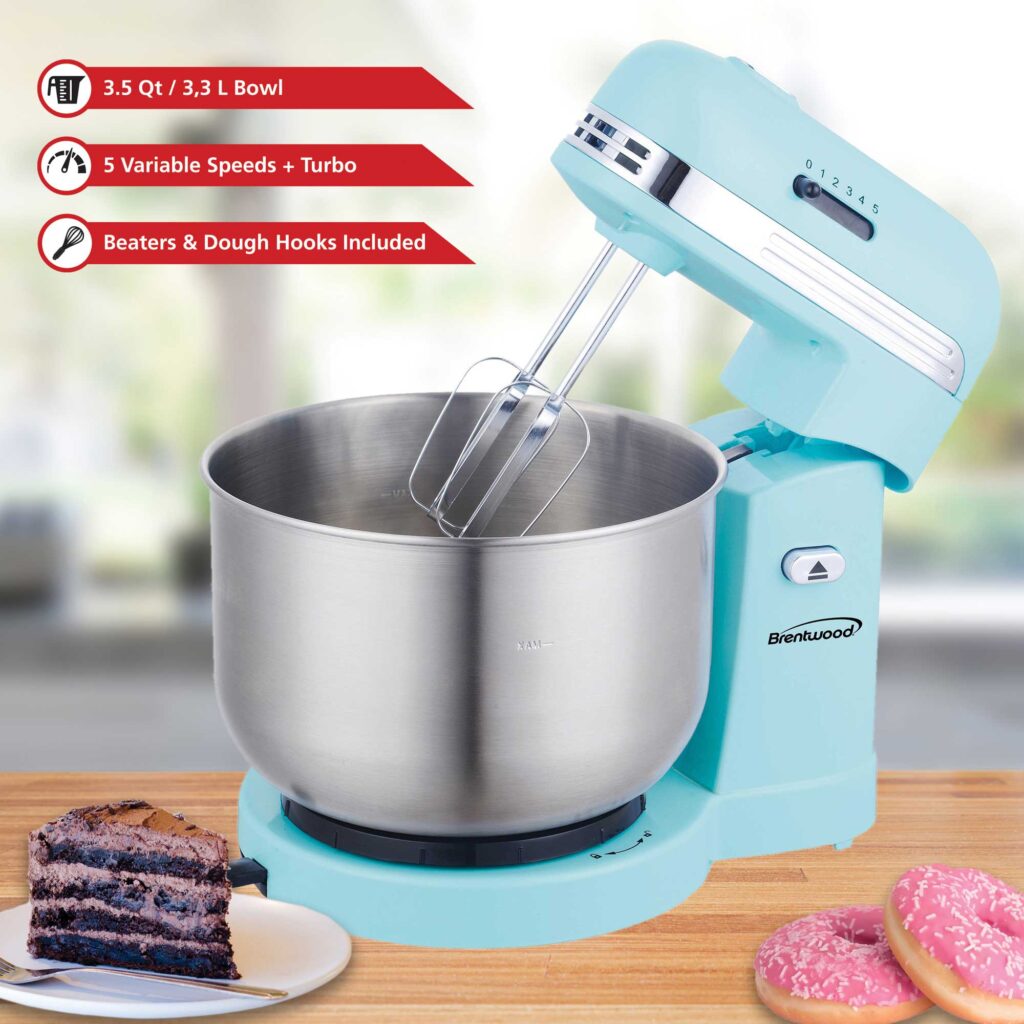
The Brentwood 5 speed stand mixer comes with a 3-quart stainless steel mixing bowl and a basic multi-speed setup, which already gives you a pretty good idea of what kind of machine this is. It is better suited to lighter kitchen tasks than demanding baking projects. In other words, this is not the mixer to buy for frequent bread baking or thick dough work.


It seems more comfortable with simpler jobs like:
- cake batter
- brownie mix
- pancake or waffle batter
- whipped cream
- simple dessert mixes
- small batches of softer cookie dough
That is really the lane where it makes the most sense. If you bake once in a while and mainly want help with lighter batters or quick dessert prep, the Brentwood 5 speed Stand Mixer may feel useful enough. But if you are expecting smooth performance with stiff dough, larger batches, or frequent heavy mixing, that is where its limitations become much harder to ignore.
The First Thing You’ll Notice: It’s Light
Some stand mixers feel planted. This one feels light right away.
That can be a good thing if you have a small kitchen or hate hauling heavy appliances out of cabinets. The Brentwood 5 speed stand mixer is easier to move around than bulkier models, and for some people that alone will make it more usable. A mixer that’s easy to grab often gets used more than a better one that feels annoying to lift.
Still, the trade-off is pretty obvious. Lighter mixers tend to feel less grounded on the counter, especially once you move beyond thin batters. That pattern shows up here too. A machine can be compact without feeling flimsy, but this one leans closer to the “light-duty” side than the “compact but solid” side.
The 3-quart stainless steel bowl is one of the nicer parts of the package. I tend to notice bowl design more than most people do, mostly because bowl depth and shape quietly affect everything. A bowl can look fine in photos and still be annoying in actual use. Here, the size is okay for smaller recipes, but it’s not especially generous. If you double recipes often, or like making large batches of cookie dough in one go, this bowl is going to feel limiting pretty quickly.
How It Feels in Real Kitchen Use
This is where the Brentwood stand mixer becomes easier to judge. For light batters, it seems to do reasonably well. It mixes, the speed options are simple enough, and it doesn’t ask much from the user. You’re not getting some impressively smooth, premium-feeling experience, but you are getting a basic mixer that can help with ordinary baking tasks.
That said, there’s a difference between “works” and “works comfortably.”
For thinner mixtures, the machine is usually fine. For thicker ones, you start to see its personality a little more, and not always in a good way. Users commonly mention that it can wobble at higher speeds, and that sounds believable for a mixer built this light. That kind of movement may not ruin the task, but it does make the whole experience feel less relaxed. You stay alert. You keep an eye on it. It’s not the sort of stand mixer that inspires much confidence when you walk away for a second.
Another small but important issue with budget mixers like this is bowl coverage. When the beater doesn’t quite catch everything cleanly, you end up stopping to scrape the sides more often than you want. It’s not a disaster, but it turns the mixer into something that still needs babysitting. That’s one of those details people often overlook before buying, and then notice almost immediately after.
Brand Reputation, Warranty, and What That Really Means
Brentwood is one of those appliance brands that seems to live mostly in the budget end of the market. It has been around for a long time and sells a wide range of small kitchen and household products, which at least gives it more of a real-brand presence than the random pop-up names that appear online and disappear a year later. That said, Brentwood still feels much more like a value brand than a brand people shop for because of long-term performance or premium build quality.
That context matters with this mixer. A budget brand can still make a perfectly useful product, but buyers usually need to go in with the right expectations. With Brentwood, the appeal is usually price, availability, and simplicity, not the feeling that you are buying something especially refined or heavy-duty.
On the warranty side, Brentwood says most of its appliances come with a 1-year limited warranty, although the company also notes that coverage can vary by model, so it is worth checking the instruction manual for the Brentwood 5 speed stand mixer specifically before buying. The company also has a support page, product registration, and contact options for warranty service and replacement-part questions, which is reassuring to see on a lower-cost appliance.
Still, warranty coverage only helps so much. If a product is inexpensive but also gives buyers concerns about attachments, bowl movement, or overall durability, the warranty becomes more of a safety net than a reason to feel confident. That is probably the fairest way to look at Brentwood as a brand here. It feels more established than many ultra-budget names, and the support path is clearer than expected at this price level, but that does not automatically erase the quality concerns some buyers have raised. In other words, the brand makes this mixer feel a little less risky, just not risk-free.
Mixing Dough? That’s Probably Not Its Strong Side
This is the part where it helps to be realistic. The Brentwood 5 speed stand mixer is not the mixer I’d point someone toward for bread dough, pizza dough, or anything thick enough to really push against the motor.
A lot of low-cost stand mixers technically can mix dough in the same sense that a budget laptop can technically edit video. Yes, maybe. But the experience won’t be great, and the machine will remind you that it was not built for that kind of work.
With heavier doughs, the likely issues are pretty predictable:
- the motor starts to sound strained
- the mixer may shake or shift more than you’d like
- mixing becomes uneven unless you step in
- long-term durability becomes a bigger question
That doesn’t make it useless. It just makes it specialized in a very ordinary, limited way. If your kitchen routine is mostly soft batters and light mixing, that may be enough. If you bake bread every weekend, I think you’d outgrow this model fast.
Ease of Use Is One of Its Better Points
To be fair to it, the Brentwood stand mixer does have one advantage that budget appliances sometimes lose when they try too hard to look fancy: it’s simple.
There isn’t much to figure out here. The controls are straightforward, the overall setup is basic, and it doesn’t feel intimidating for beginners. That matters. A lot of shoppers looking at a mixer in this price range are not trying to build a serious baking station. They just want something easier than a hand mixer and less expensive than the bigger names.
For that kind of buyer, this mixer probably feels approachable in a good way.
Cleaning and Everyday Annoyance Level
Cleaning looks like a small detail until you’re scraping frosting off attachments after dinner and regretting your life choices. So I never really treat cleanup as a minor thing.
This is one area where the Brentwood 5 speed stand mixer seems fairly manageable. The stainless steel bowl is easier to deal with than a cheap-feeling plastic one, and the overall setup appears uncomplicated enough that cleanup doesn’t turn into a whole second event. That’s genuinely useful.
I also think mixers like this live or die by how annoying they are after the mixing is done. If the bowl is awkward, if batter gets stuck in weird places, if attachments feel like a hassle to remove, the machine starts losing appeal very quickly. Brentwood seems to avoid the worst of that here. It may not feel premium, but it also doesn’t sound especially fussy.
Seeing the Differences Side by Side Helps
These three stand mixers make more sense when you look at them as budget options for shoppers trying to stay under roughly the $100 mark. None of them are really aiming at serious, heavy-duty baking. They’re all trying to offer a cheaper way into stand mixers, just with slightly different priorities. One stays very basic, one feels a bit more polished for small kitchens, and one tries to look like the bigger, more ambitious option without leaving the budget category.
| Feature | Brentwood 5 Speed Stand Mixer Model Reviewed | Kitchen in the Box 3.2Qt Mini Stand Mixer | Acekool 7.5QT Stand Mixer |
|---|---|---|---|
|
Design
A quick visual look at each mixer’s overall size, shape, and layout. |
 |
 |
 |
|
Bowl Capacity
How much each mixer can handle before it starts feeling cramped or impractical for everyday baking |
3 quart | 3.2 quart | 7.5 quart |
|
Speed Settings
More speeds can help with control, though they do not automatically fix weak mixing performance |
5 speeds | 6 speeds | 10 speeds |
|
Countertop Feel
How the mixer is likely to feel in a real kitchen once batter gets thicker and the motor has to work harder |
Very lightweight, but also the most likely to feel basic | Still compact, but a little more thought-out for small-space daily use | Bulkier and heavier, with a more planted feel |
|
Best Use Case
The kind of baking each mixer seems most naturally suited for |
Light batters, whipped cream, simple occasional baking | Small-batch baking for apartments, couples, or beginners | Larger batches and shoppers who want more room for dough and mixing volume |
|
Main Trade-Off
What you are giving up in exchange for the price and feature set |
Feels the most stripped-down of the three | Still a small mixer, so capacity is limited | Looks stronger on paper, but it is still a budget mixer and may not feel as refined as the size suggests |
What makes this comparison more interesting is that all three sit in a similar price conversation, but they do not really make the same promise. The Brentwood is the simplest of the bunch. It feels like the pick for someone who just wants a cheap stand mixer for light jobs and does not expect much beyond that. The Kitchen in the Box model goes after that same general buyer, but in a slightly smarter way. It is still compact and budget-friendly, though it feels more intentionally built for small kitchens and modest day-to-day baking. The Acekool goes in a different direction. It offers a much larger bowl and more speed settings, which sounds attractive, but big capacity in the budget range can be a little misleading. A large bowl does not automatically mean premium performance. So really, this comes down to what kind of compromise you dislike less: Brentwood’s basic feel, Kitchen in the Box’s smaller footprint, or Acekool’s bigger but still budget-minded approach.
Pros of the Brentwood 5 Speed Stand Mixer
To be fair, not every review was frustrated. Some buyers really did seem happy with the Brentwood 5 speed stand mixer, especially when they used it for lighter, simpler jobs and didn’t expect too much from it. The positive comments were pretty consistent in a few areas: it’s easy to use, easy to clean, and small enough that it doesn’t feel like a giant countertop commitment. For some people, that alone is enough.
A few reviewers described it as a “good little mixer,” which honestly feels like the right phrase. Not amazing. Not impressive. Just decent for basic baking. One customer liked that the bowl rotated on its own instead of needing to be turned by hand, which is the kind of small thing that actually matters when you’re standing there making cake batter and don’t want to babysit the machine. Another said it worked well for everyday use and cleaned up easily afterward, and that’s probably where this mixer makes the most sense: soft batters, simple mixes, maybe a casual weekend cake, not much more ambitious than that.
There’s also a pattern in the better reviews that’s worth noticing. People who liked it generally seemed to buy it with pretty modest expectations. They wanted something cheap, compact, and functional for occasional use, and in that narrow lane, the mixer seems capable of doing the job. If your baking is light and your standards are realistic, I can see why some buyers came away satisfied.


Cons of the Brentwood 5 Speed Stand Mixer
The problem is that once you read the negative reviews, the weaknesses start sounding less like random bad luck and more like part of the product. The biggest complaints come back to the same things over and over: lightweight construction, awkward attachments, inconsistent bowl movement, and parts that don’t seem built for much stress. More than one buyer described the bowl as flimsy or too light, and several mentioned beaters or dough hooks getting stuck, snapping, or just feeling cheap. That’s not a small annoyance. That’s the kind of issue that makes a mixer feel like a short-term purchase before it even earns a permanent spot in the kitchen.
A lot of the frustration also came from how it behaves during actual mixing. Some users said the bowl was hard to lock into place, while others said it rotated badly or even seemed to grind into the base. A few people mentioned constant scraping because the beaters didn’t reach the bowl well enough, which kind of defeats the point of using a stand mixer in the first place. One reviewer said even speed one was too fast and caused splashing, and that’s exactly the sort of thing that makes a cheap mixer feel more annoying than helpful. You save money up front, then spend the whole time wiping batter off the counter.
Then there are the durability complaints, and those are harder to brush aside. Broken dough hooks, rusting beaters, a lingering burning smell, a snapped tilt-head button on first use. That’s rough. Budget mixers do not need to feel luxurious, but they do need to feel like they can survive ordinary baking without acting like they’re being pushed past their limits. Based on the harsher reviews, this one doesn’t always manage that. The Brentwood 5 speed stand mixer seems most workable when used gently, for light mixes, by buyers who are willing to forgive a lot. Once you ask for sturdiness, smoother control, or reliable dough mixing, it starts to look like the kind of bargain people regret later.
The Common Complaints Make Sense
After reading through feedback patterns on mixers in this category, the complaints that tend to surface around the Brentwood stand mixer are the ones you’d expect, which honestly makes them easier to trust.
- It feels underpowered for thick mixtures. This is probably the biggest one.
- The 3-quart bowl runs small. Fine for modest recipes, less fine for ambitious ones.
- It can feel unstable. Especially once the mixer has to work a bit harder.
- Long-term durability is a question mark. Occasional use is one thing; frequent strain is another.
None of that is shocking, but it matters because some shoppers buy a budget mixer thinking they’re making a smart compromise, when really they’re buying something that only works well for a narrow slice of kitchen tasks.
Who This Mixer Will Probably Work For
The Brentwood 5 speed stand mixer feels most at home in a kitchen where baking happens once in a while, not every other day. It makes more sense for someone who wants a simple, compact mixer for lighter recipes and doesn’t need it to do anything ambitious. If most of your baking looks like cake batter, brownie mix, whipped frosting, or the occasional batch of cookies, this is the kind of machine that may feel good enough without asking for a big investment.
It also fits better in smaller kitchens where storage matters. A bulky stand mixer can be annoying if you have to wrestle it in and out of a cabinet every time you want to use it. Brentwood’s lighter size is actually one of its more practical qualities. For someone who mainly wants convenience and a low entry price, that can be enough to make it worth considering.
Really, this mixer works best for buyers who understand what they are buying before it even arrives. It is not a serious baking machine. It is a basic, budget stand mixer for simple kitchen jobs. And honestly, people tend to be happiest with products like this when they expect exactly that and nothing more.
Who Will Probably Outgrow It Fast
This is probably not the right mixer for someone who bakes often or leans toward heavier recipes. If you make bread regularly, mix thicker doughs, or tend to bake in large batches, Brentwood is likely to feel small and a little underbuilt before long. The same goes for anyone who wants a mixer that feels solid on the counter and can run without much fuss.
It is also easy to see this becoming frustrating for shoppers who are bothered by the little things. Extra bowl scraping, wobble at higher speeds, attachments that do not feel especially sturdy, a motor that sounds strained sooner than you would like. Budget mixers can get away with a few compromises, but once those compromises start showing up every time you bake, the low price stops feeling like much of a win.
That is really the risk here. If you buy it for light, occasional use, it may feel perfectly acceptable. If you buy it hoping it will grow with you, there is a good chance you will end up replacing it.
Is It Good Value?
This depends almost entirely on how you define value.
If value means getting the cheapest possible stand mixer that can handle light baking tasks without much fuss, then yes, the Brentwood stand mixer has a reasonable argument. It covers the basics, it looks approachable, and it doesn’t ask for much money up front.
If value means buying something that feels durable, flexible, and satisfying to use for years, I’d be more hesitant. A low upfront price is nice, but it stops looking like a bargain when the appliance feels strained by the very tasks you bought it for.
That’s the real tension here. It may be affordable, but it’s also easy to imagine someone outgrowing it quickly.
See Best-Selling Stand Mixers on Amazon
My Take
The Brentwood 5 speed stand mixer is not terrible. I actually think calling it terrible would be lazy. It has a purpose, and for the right person, it could be a useful little mixer.
But it’s also the kind of product where the limitations are not subtle. They’re part of the experience. You’ll probably notice the smaller bowl. You’ll probably notice the lighter build. And if you ask too much from it, you’ll definitely notice that too.
So here’s the honest version: if you bake lightly, keep portions modest, and mostly want a simple mixer that’s easier than using a hand mixer for every little task, the Brentwood stand mixer may do enough to earn its place. If you want a mixer you can grow into, I’d keep looking.
Sometimes a budget appliance is a hidden gem. This one feels more like a decent compromise. That’s not the same thing, and it’s worth knowing before you buy.
gf
