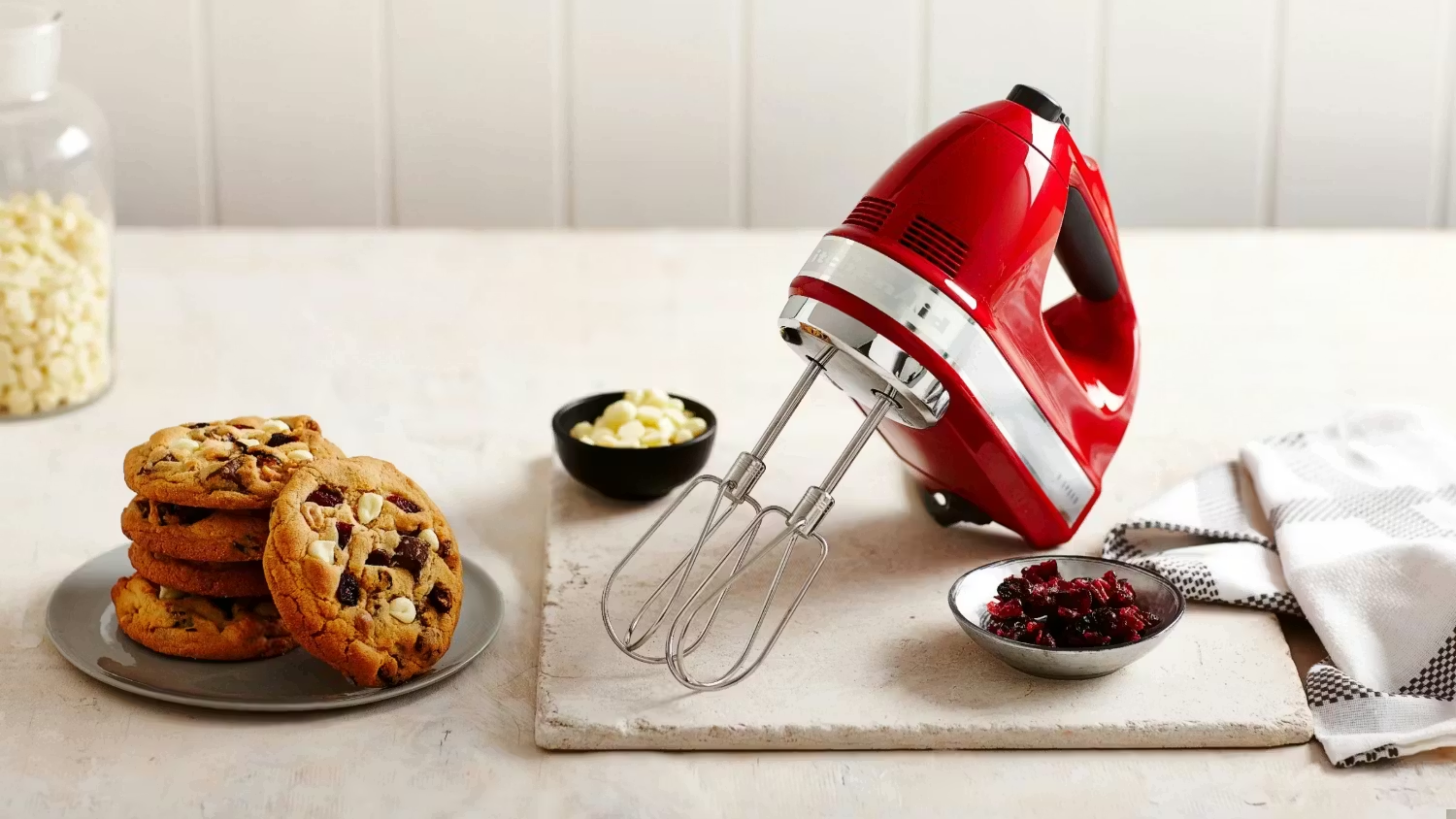
The KitchenAid Hand Mixer 7-Speed shows up everywhere. Not in an aggressive, “you must buy this” kind of way—but more like it quietly exists in a lot of kitchens.
You’ll see it in the background of baking videos. On countertops in random Instagram posts. Maybe even at a friend’s place where it just sits there like it’s always belonged.
That alone says something.
But it doesn’t tell you whether it’s actually worth buying. Or more importantly, whether it still feels like a good choice after a few months of real use—not just the first impression phase where everything feels new and slightly exciting.
So instead of treating this like a clean, polished product breakdown, I want to get into what this mixer actually feels like over time. The good parts, the slightly annoying parts, and the stuff you don’t really notice until you’ve used it enough times that it becomes routine.

First Impressions: Nice, But Not Trying Too Hard
The first thing you notice about the KitchenAid 7-Speed Hand Mixer is that it looks… put together. Not flashy. Not overly designed. Just clean.
The colors are probably nicer than they need to be. If you’re someone who cares even a little about how your kitchen looks, you’ll appreciate that. If not, it’s just a mixer that doesn’t look cheap.
Pick it up, and it feels light. That’s a good thing, mostly. You don’t want a heavy hand mixer unless you enjoy wrist fatigue for no reason.
But it’s not feather-light either. There’s just enough weight to keep it from feeling hollow. Somewhere in the middle. You can tell it’s not a $15 mixer, but you’re also not holding something that screams “premium build.”
The buttons are simple. No learning curve. You won’t need to check the manual just to turn it on, which—honestly—is more valuable than it sounds.
And then there’s the digital speed display. It’s one of those features that feels unnecessary at first. But after a few uses, you realize it’s kind of nice to know exactly what speed you’re on instead of guessing.
Still, nothing here feels impressive. It just feels… sensible.
The Speed Settings: Where It Quietly Wins
Seven speeds sounds like marketing fluff. I thought that too.
But after using it for a bit, you start noticing something: the low speeds actually behave like low speeds.
That shouldn’t be rare. But it is.
A lot of cheaper mixers claim to start slow, but they don’t. You tap the button and suddenly flour jumps out of the bowl like it’s trying to escape.
This one doesn’t do that. It starts gently. Not perfectly slow, but slow enough that you don’t immediately regret your life choices.
And the transitions between speeds feel smooth. No sudden jumps. You can move from mixing dry ingredients to thicker batter without that awkward moment where everything splashes or clumps.
In practice, you end up using it like this:
- Speed 1–2: For not making a mess. Seriously, this is where it earns points.
- Speed 3–4: Most everyday mixing happens here.
- Speed 5–6: When things start getting thicker and slightly more demanding.
- Speed 7: Whipping, finishing, or just trying to get things done faster.
It’s not groundbreaking. But it feels more controlled than a lot of mixers in this range.
Using It in a Real Kitchen (Not Just One Test Recipe)
This is where the KitchenAid Hand Mixer 7-Speed starts to show its personality a bit.
Cake Batter: No Drama, Which Is a Good Thing
Cake batter is easy. Maybe too easy to judge a mixer on, but still worth mentioning.
This thing handles it without hesitation. No uneven mixing. No weird pockets of flour hiding at the bottom. It just works.
You stop thinking about it after a minute, which is probably the best outcome you can hope for.
Cookies: Slightly More Honest
Cookies are more revealing.
If you’re making a soft dough, like standard chocolate chip cookies, it’s fine. Not fast, not slow—just steady.
But when the dough gets thicker, especially if you’re working with something chilled or heavy on ingredients, you start to feel the limit.
The motor doesn’t fail. It just sounds like it’s working harder than it wants to.
You instinctively ease off a bit. Maybe mix in stages. Maybe stop to scrape the bowl more often.
It’s manageable. But it’s not effortless.
Whipped Cream: Reliable, Not Impressive
Whipping cream with the KitchenAid 7-Speed Hand Mixer is… fine.
It gets there. It doesn’t struggle. But it’s not particularly fast either.
If you’ve used a stronger mixer before, you’ll notice the difference. If you haven’t, you probably won’t think twice about it.
The whisk attachment helps a little, but not enough to feel like a major upgrade.
Heavier Mixing: You’ll Hit the Ceiling
At some point, you’ll try something slightly ambitious. Maybe a thick dough. Maybe something you shouldn’t be mixing with a hand mixer in the first place.
That’s when the KitchenAid reminds you what it is.
The motor sound changes. The resistance increases. You feel it in your hand.
It’s not subtle.
And honestly, that’s fine. It’s doing what a hand mixer is supposed to do—just not more than that.
Attachments and Storage: Practical, Not Exciting
You get what you expect:
- Two stainless steel beaters
- A whisk attachment
- A small storage bag
The beaters are solid. They do their job.
The whisk is useful occasionally, but it’s not something you’ll reach for every time.
The storage bag is one of those things you don’t think about until you realize it’s actually helpful. Keeping everything in one place saves you from digging through drawers later.
But the bag itself feels a bit cheap. Not terrible—just not something you’d trust to last forever.
What It Actually Felt Like to Use (After a Few Weeks, Not Just One Recipe)
I didn’t want to judge the KitchenAid Hand Mixer 7-Speed after just one batch of cookies. That’s usually how you miss the small things—the stuff that only shows up when you’ve used it enough times that the “new tool excitement” wears off.
So I ended up using it across a mix of everyday recipes. Nothing fancy. The kind of things most people actually make at home.
Week 1: “Okay, this is easier than my old mixer”
The first thing I made was a basic chocolate cake. Pretty forgiving recipe. The kind where even a mediocre mixer can get you through.
But right away, the slow start stood out. I added flour, turned it on at speed 1, and… nothing flew out of the bowl. No flour cloud. No instinctive flinch.
That sounds small, but if you’ve used cheaper mixers, you know exactly how annoying that can be. Some people specifically call this out as the main reason they switched—other mixers felt like they only had “fast, faster, fastest,” not a real low speed.
Mixing itself felt smooth. Not fast, not slow. Just steady. I didn’t have to stop and scrape the bowl constantly, which surprised me a bit.
At this point, I was thinking: yeah, this feels like a small upgrade.
Week 2: Cookies and a Bit of Reality
Next up was cookie dough. Classic test.
The first batch—standard chocolate chip—was fine. No complaints. But the second batch was thicker, with oats and nuts, and that’s when I started to notice the limits.
The mixer didn’t stall, but it definitely sounded like it was working harder. You can feel it through your hand. It’s subtle, but it’s there.
Interestingly, some people say it can handle thicker doughs better than expected, even things like wedding cookies or heavier batters. And I can see that—but it’s right on the edge of what feels comfortable.
I wouldn’t push it too often.
Week 3: Whipped Cream, Eggs, and Noise (or Lack of It)
This is where I started noticing something I didn’t expect: how quiet it is.
I made whipped cream and later whisked egg whites for waffles. Even at higher speeds, it didn’t have that harsh, high-pitched noise that some mixers have.
One reviewer mentioned being able to use it while someone was on a Zoom call in the next room—and that actually checks out.
That said, speed-wise… it’s not aggressive.
It gets the job done, but if you’re used to a faster mixer, it might feel a little underpowered. A few people even mention that the top speed doesn’t feel as strong as expected, especially for whipping tasks.
I kind of agree with that. It’s capable, just not exciting.
Week 4: Small Annoyances Start Showing Up
By the fourth week, the bigger picture started to settle in—and so did the small annoyances.
The speed buttons, for example. They’re not terrible, but they’re not intuitive either. You have to step through speeds each time, and if you stop mid-task, you’re starting over again from low.
Some people don’t mind this at all. Others find it awkward, especially compared to older mixers with a simple slider control.
I’m somewhere in the middle. It works, but it’s not my favorite design.
Then there’s the beater performance.
Most of the time, it mixes well. But occasionally—especially with thicker or uneven mixtures—you’ll find small pockets that don’t fully incorporate unless you help it along with a spatula.
That’s not unique to this mixer, but it happens just enough to notice.
After a While: You Stop Thinking About It
This is probably the most honest part.
After a few weeks, the KitchenAid Hand Mixer 7-Speed just becomes part of your routine.
You grab it for quick jobs. You don’t overthink it. You don’t dread using it.
It’s especially useful for smaller tasks where pulling out a stand mixer feels like too much effort. A lot of people use it exactly this way—as a companion tool rather than a replacement.
And that’s where it makes the most sense.
What I Ended Up Liking (Pros)
- The low speed is genuinely useful – probably the biggest practical advantage. Less mess, less frustration.
- Comfortable to hold – lightweight, balanced, doesn’t feel tiring for normal use.
- Quiet operation – noticeably calmer than a lot of mixers, especially cheaper ones.
- Reliable for everyday baking – cakes, batters, lighter doughs all feel easy.
- Good as a “quick-use” mixer – perfect when you don’t want to deal with a stand mixer.
What Started to Bother Me Over Time
The frustrating thing about the KitchenAid Hand Mixer 7-Speed is that its weaknesses do not always show up right away. On the first few uses, it can feel smooth, tidy, and easy to like. Then you keep using it, and the trade-offs become more obvious. None of them are disastrous on their own. That is almost what makes them more noticeable. They are the kind of small disappointments that slowly change the tone of the experience.
- It is capable, but not especially strong – For cake batter, basic frostings, mashed potatoes, and lighter cookie doughs, it does well enough. But once the mixture gets thicker, the mixer starts to feel more cautious than confident. You can hear the motor working harder, and you instinctively adjust your expectations a little. It is not weak in a useless way. It just never feels eager.
- The top speed sounds more promising than it feels – This is probably the part that leaves the strangest impression. The mixer is calm and controlled at the low end, which I genuinely like, but the upper end never feels especially fast or forceful. For whipped cream or egg whites, it gets there eventually, but not with the kind of urgency that makes you think, yes, this thing really has range. If that matters to you, the step up to the KitchenAid 9-Speed Hand Mixer starts to make more sense.
- The controls are not terrible, but they are less natural than they should be – The up-and-down button system is one of those designs you can learn, but never fully love. It works, sure. But it does not disappear into the background the way a good control system should. If you stop in the middle of mixing, then want to return to a higher speed, it feels a little more fiddly than necessary.
- Thicker mixtures sometimes expose the limits of the beaters – Most of the time, the mixing action is perfectly fine. But with denser doughs or stubborn pockets of ingredients, you may find yourself stopping to scrape, press, or manually help things along. That does not ruin the mixer, but it changes the feeling from effortless to slightly supervised. I kept noticing that it worked best when I stayed within its comfort zone.
- It invites the value question more than I expected – This is the one that lingers. The mixer is good. I do not think that is in doubt. But it is not so clearly better than cheaper hand mixers that the higher price automatically feels justified for everyone. You are paying for better control, quieter operation, and a nicer overall feel. What you are not getting is a dramatic jump in raw performance.
That is really the tension with this mixer. It is easy to appreciate, but a little harder to feel strongly about. It fits into your kitchen without much friction, and for some people that is enough. For others, especially if you expected more authority at the top end, it can leave you with the feeling that it is good in a careful way rather than great in a memorable one.
And depending on what you want from a hand mixer, that can either feel reassuringly sensible or just a little underwhelming.
The Cord Design: One of Those “Nice Idea, Not for Me” Things

Lockable Swivel Cord
I’ll be honest—this is one part of the KitchenAid Hand Mixer 7-Speed that never really clicked for me.
KitchenAid uses a swivel cord here. In theory, it’s supposed to be more flexible. You can angle it left or right depending on where your outlet is, and it’s meant to stay out of your way while you’re mixing.
And I can see what they were going for. On paper, it sounds thoughtful.
In real use… I didn’t love it.
The main issue is where the cord connects. It comes out from the base instead of the back, which means it doesn’t naturally “trail behind” the mixer the way most cords do. When you’re moving the mixer around the bowl—and you always are—it sometimes ends up drifting into your space instead of away from it.
I noticed this most when making cookie dough. You’re already dealing with a thicker mixture, moving the mixer slowly around the bowl, and then the cord sort of swings into your wrist or brushes against the side of the bowl. Not constantly, but often enough that you notice it.
There were a few times where I caught myself holding the cord with the same hand, just to keep it out of the way. That’s not something I’ve ever had to do with a regular hand mixer.
Another thing is that you have to think about it. With a standard cord, you don’t. It just sits behind the mixer and stays there. With this one, you’re occasionally adjusting it, or noticing that it shifted slightly while you were mixing.
It’s not a big interruption, but it breaks that “grab it and forget about it” flow a little.
To be fair, I get why some people like it. If your outlet is awkwardly placed, being able to angle the cord could be helpful. And if it happens to line up well with your setup, you might never think about it at all.
But for me, it felt like a feature that solves a problem I didn’t really have—and in some situations, it created a small new one.
What I personally liked:
- The idea behind it is thoughtful
- It can help in certain kitchen layouts
What didn’t work for me:
- Doesn’t naturally stay out of the way like a rear cord
- Sometimes drifts into your wrist while mixing
- Feels like something you have to manage instead of ignore
If I’m being blunt, I’d take a simple, fixed rear cord over this any day. It’s less clever—but also less noticeable, which is kind of the point.
Comfort and Handling: One of Its Stronger Points
This is where the KitchenAid 7-Speed Hand Mixer quietly stands out.
It’s comfortable to hold. The weight is balanced. The handle doesn’t feel awkward or overly shaped.
You can use it for a few minutes without any issue.
Longer sessions—especially with thicker mixtures—will still tire your hand. That’s unavoidable.
But compared to bulkier or heavier mixers, this one feels easier to deal with.
The Cord: Slightly Annoying in Real Life
The swivel cord sounds like a nice idea.
And sometimes, it is.
But other times, it still ends up in the way depending on how you’re standing or where your outlet is.
It’s not a huge problem. Just one of those little things you notice more over time.
Comparing It to Cuisinart and Hamilton Beach
This is where things get clearer.
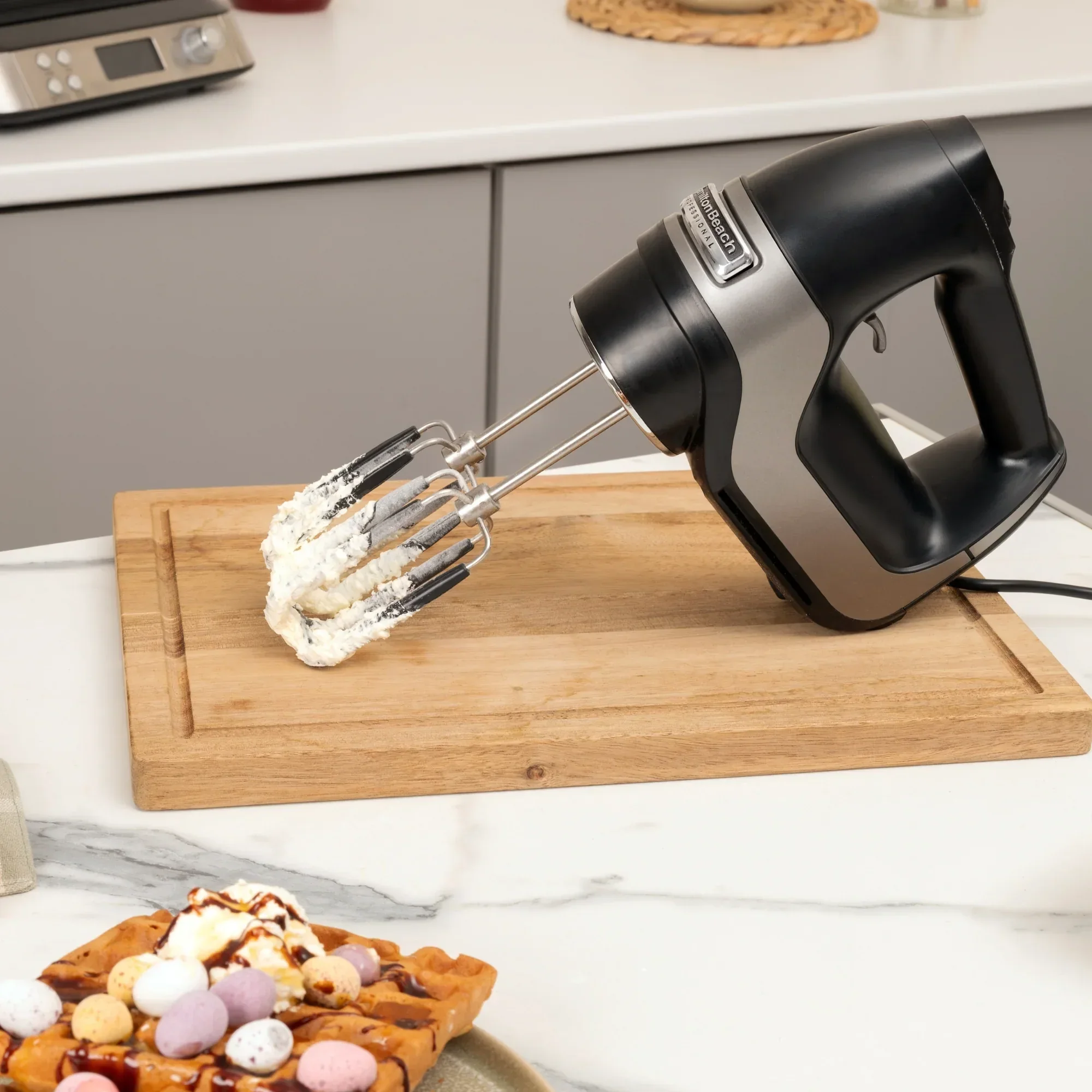
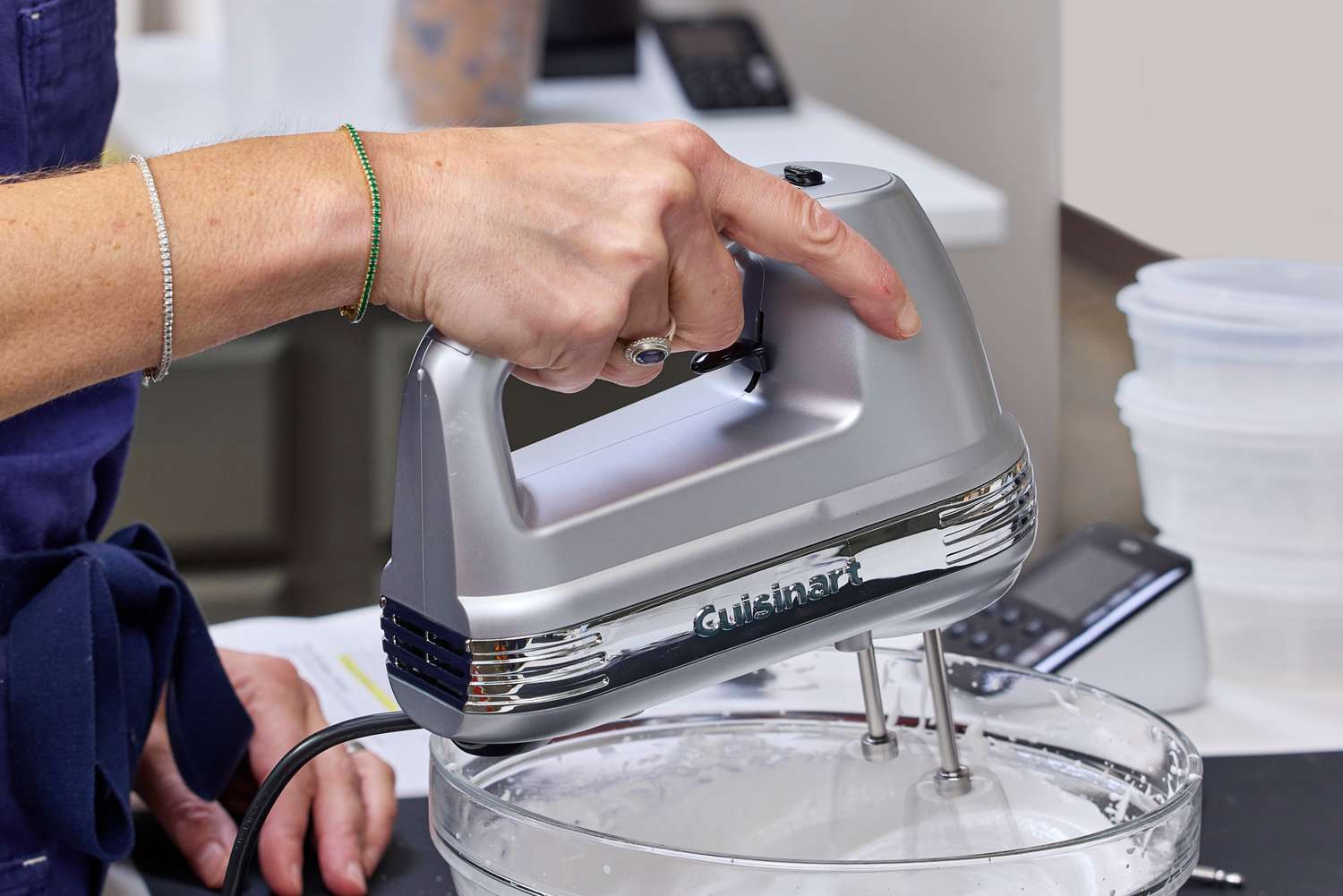
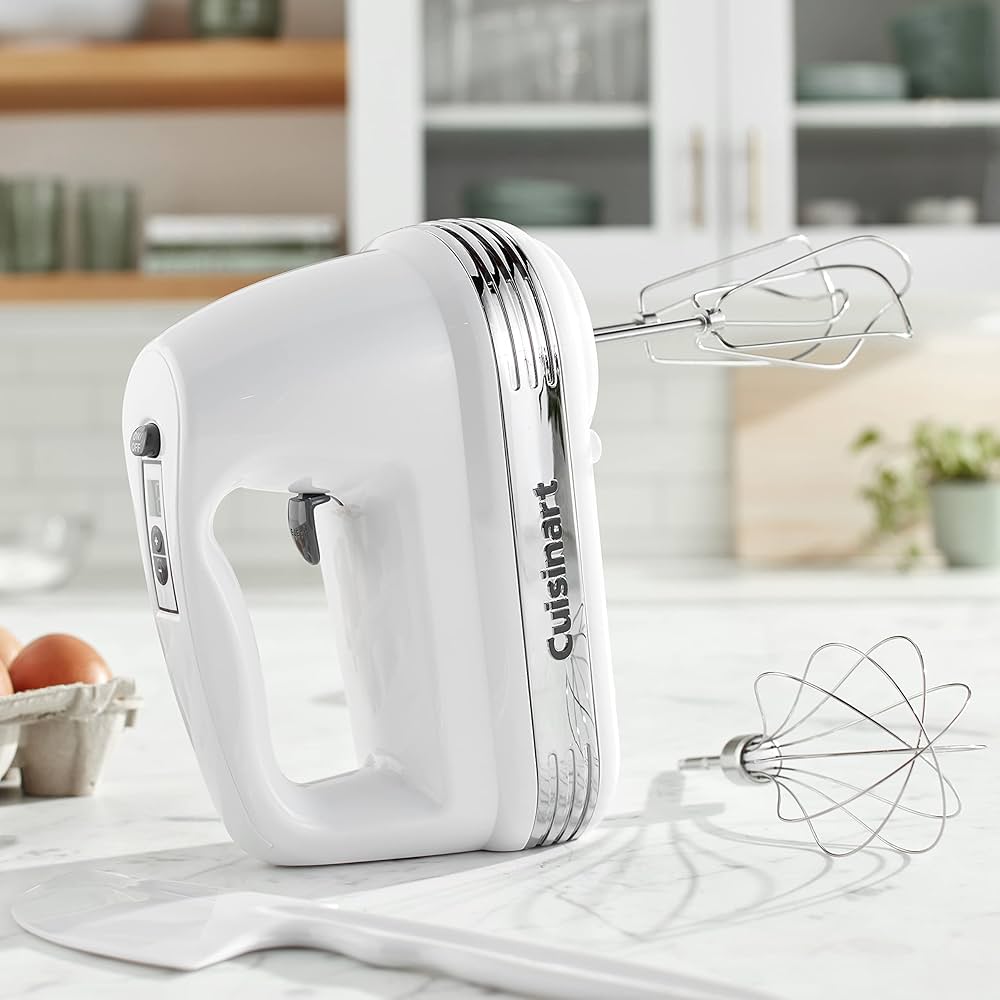
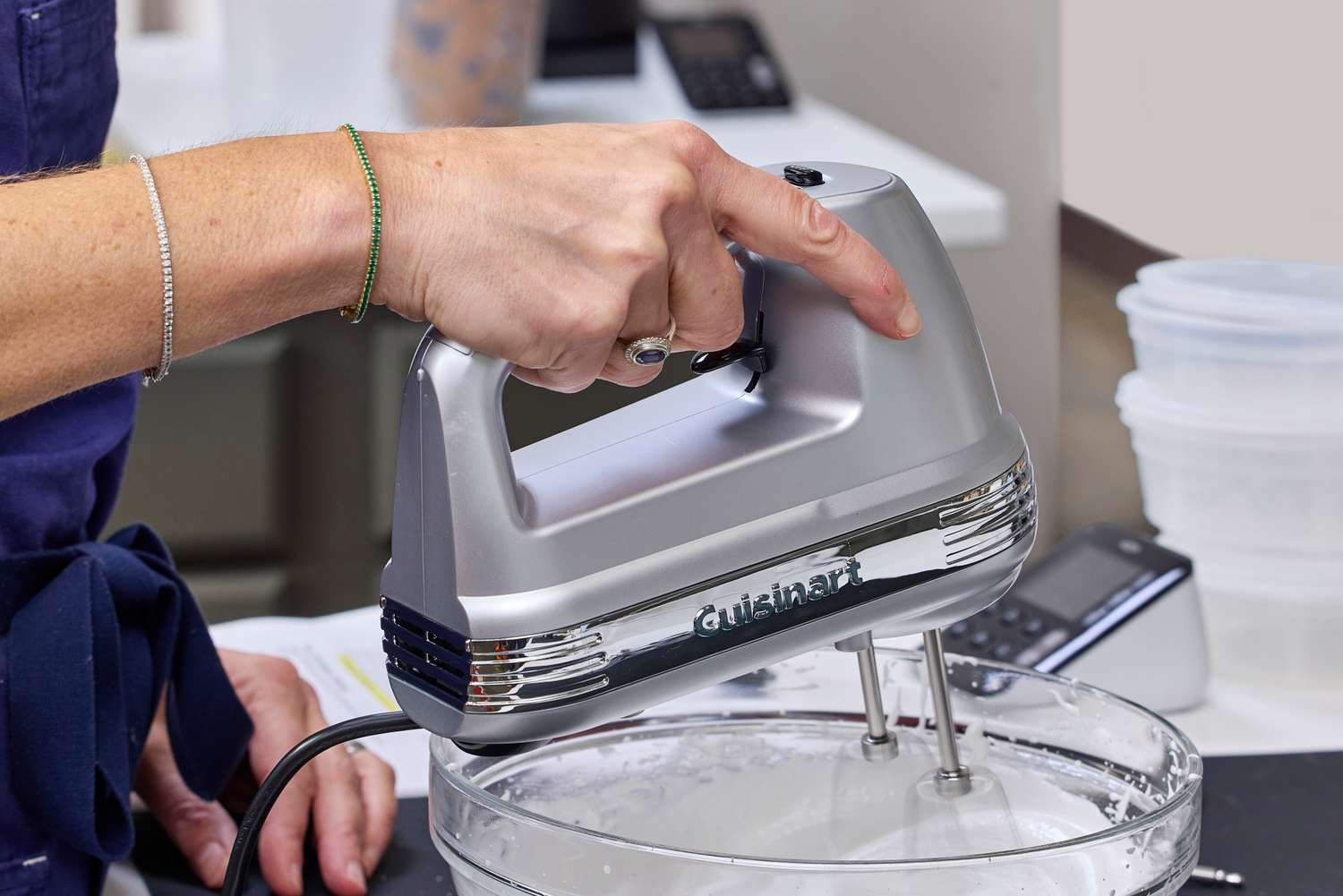
Because the KitchenAid Hand Mixer 7-Speed isn’t competing in a vacuum. Most people looking at it are also considering something like the Cuisinart Power Advantage 7-Speed or the Hamilton Beach 6-Speed Electric Hand Mixer.
And they each feel different in ways that matter.
| Feature | KitchenAid 7-Speed Hand Mixer Model Reviewed | Cuisinart Power Advantage 7-Speed Hand Mixer | Hamilton Beach 6-Speed Electric Hand Mixer |
|---|---|---|---|
|
Everyday Feel
What it feels like during regular baking |
Smooth, controlled, easy to use | More practical, slightly less refined | Basic, lighter, less polished |
|
Speed Control
How the speeds behave in real use |
Very gradual and predictable | Good, but less smooth | More abrupt transitions |
|
Power
Handling thicker mixtures |
Moderate | Stronger overall | Lower power |
|
Build Feel
How solid it feels in hand |
Balanced and comfortable | Solid but less polished | Feels more budget-focused |
|
Best For
Who it suits best |
Regular home bakers | People who want more flexibility | Occasional, simple use |
|
Main Trade-Off
What you give up |
Price vs power | Less refined feel | Lower durability and control |
If I had to simplify it: KitchenAid feels the nicest, Cuisinart feels more capable, and Hamilton Beach feels… fine, but basic.
What Starts to Bother You Over Time
No product is perfect, and this one has a few things that become more noticeable the longer you use it.
It’s Not Very Powerful
This is the biggest one.
It’s fine for most tasks, but you’ll occasionally wish it had just a bit more strength. Especially if you bake often.
The Price Feels Slightly High
You’re paying for the brand. That’s not necessarily a bad thing—but it’s noticeable.
There are cheaper mixers that do similar things. They just don’t feel quite as nice.
It Doesn’t Get Better Over Time
Some kitchen tools grow on you.
This one stays the same. Which is good—but also kind of neutral.
What It’s Like After a Few Months
This is where the KitchenAid 7-Speed Hand Mixer makes the most sense.
After a while, it just becomes part of your routine.
You grab it without thinking. Use it. Clean it. Put it back.
No frustration. No surprises.
It doesn’t try to impress you—it just stays consistent.
And honestly, that consistency is probably why so many people keep it.
Where This Mixer Really Lands
The KitchenAid Hand Mixer 7-Speed is not the hand mixer that wins on brute force, and it is definitely not the one you buy because it feels like a bargain. If that is the shopping mindset, this model can feel a little irritating, honestly. You look at the price, you use the highest speed, and part of you keeps waiting for a bigger payoff.
But that is also not really what this mixer is built around.
What it does better than a lot of hand mixers is make the everyday stuff feel calmer. The low speed is actually usable. The body feels balanced in the hand. It does not scream, jerk, or throw ingredients around the bowl the second you turn it on. There is a kind of quiet competence to it that grows on you, especially if you bake often enough to care about small annoyances. And small annoyances are exactly what ruin a hand mixer over time.
That said, I do not think this is one of those products that makes sense for everyone just because the name says KitchenAid. If you want a mixer that feels eager, fast, and a little more aggressive with thicker mixtures, this one may come off as too polite. That is really the word for it: polite. It behaves well. Sometimes almost a little too well. It rarely feels messy or chaotic, but it also does not have that punchy, satisfying strength that makes you stop and think, okay, this thing is a beast.
So the difference comes down to what kind of frustration you dislike more. If you hate splatter, awkward handling, loud motors, and mixers that feel cheap in the hand, this one makes a strong case for itself. If you are the kind of person who can forgive a rougher mixer as long as it is stronger or cheaper, then the value here gets murkier.
That is why this model ends up being a very specific kind of good. Not exciting-good. Not unbeatable-good. More like dependable, low-drama, weeknight-baking good. The kind of mixer you reach for without rolling your eyes. The kind that earns its place by being easy to live with, not by being unforgettable.
If you want to compare it with stronger contenders and cheaper alternatives before deciding, this roundup is worth a look: Which Is the Best Hand Mixer Reviews.